


Web Scraper API
Fetch real-time data from 100+ websites,No development or maintenance required.
SCRAPING SOLUTIONS
Get accurate and in real-time results sourced from Google, Bing, and more.
With 120+ prebuilt and custom scrapers ready for any use case.
No blocks, no CAPTCHAs—unlock websites seamlessly at scale.
Execute scripts in stealth browsers with full rendering and automation
PROXY INFRASTRUCTURE
Over 100 million real residential IPs from genuine users across 190+ countries.
Reliable mobile data extraction, powered by real 4G/5G mobile IPs.
For time-sensitive tasks, utilize residential IPs with unlimited bandwidth.
Fast and cost-efficient IPs optimized for large-scale scraping.
SCRAPING SOLUTIONS
PROXY INFRASTRUCTURE
DATA FEEDS
Full details on all features, parameters, and integrations, with code samples in every major language.
LEARNING HUB
ALL LOCATIONS Proxy Locations
TOOLS
RESELLER
Get up to 50%
Contact sales:partner@thordata.com
Products $/GB
Fetch real-time data from 100+ websites,No development or maintenance required.
Get real-time results from search engines. Only pay for successful responses.
Execute scripts in stealth browsers with full rendering and automation.
Bid farewell to CAPTCHAs and anti-scraping, scrape public sites effortlessly.
Dataset Marketplace Pre-collected data from 100+ domains.
Over 100 million real residential IPs from genuine users across 190+ countries.
Reliable mobile data extraction, powered by real 4G/5G mobile IPs.
For time-sensitive tasks, utilize residential IPs with unlimited bandwidth.
Fast and cost-efficient IPs optimized for large-scale scraping.

Data for AI $/GB
Pricing $0/GB
Docs $/GB
Full details on all features, parameters, and integrations, with code samples in every major language.
Resource $/GB
EN $/GB
产品 $/GB
AI数据 $/GB
定价 $0/GB
产品文档 $/GB
资源 $/GB
简体中文 $/GB

AI models need data. The scale at which they need it — and the diversity of sources required — makes web collection an unavoidable part of the data pipeline for most teams building anything beyond toy projects.
The infrastructure challenge isn’t just writing a scraper. It’s maintaining reliable, high-volume access to web sources that increasingly recognize and block automated traffic. Residential proxies have become a standard component of serious AI data infrastructure because they’re the most effective way to collect public web data at the scale and quality that training pipelines require.
This guide covers the practical setup: why residential proxies specifically, what the configuration looks like for AI data workflows, and how to structure the collection pipeline to maximize data quality.
General web scraping and AI training data collection share the same tools, but the requirements diverge in important ways:
Volume is significantly higher. A price monitoring operation might need tens of thousands of product pages. An AI training data pipeline might need hundreds of millions of documents, pages, or structured records. The infrastructure needs to handle sustained high-throughput collection over days or weeks.
Data diversity matters. Training data quality depends partly on geographic and linguistic diversity. A residential proxy network with genuine coverage across countries and ISPs helps ensure that collected data reflects the actual diversity of the web, not just what’s accessible from a US datacenter.
Failure rates compound. In a small scraping job, a 20% failure rate is annoying. In a training data pipeline collecting 500 million pages, a 20% failure rate means 100 million missing records — a gap that can meaningfully affect model coverage. Success rate requirements are stricter.
Data provenance increasingly matters. As AI training data becomes subject to more scrutiny — both legally and in terms of model quality audits — being able to document that data was collected from real public web sources through ethically sourced infrastructure matters beyond just technical performance.
Datacenter proxies are faster and cheaper per GB. For AI data collection, the trade-off usually doesn’t hold up:
Target diversity requires residential IPs. A training corpus that includes content from e-commerce sites, social platforms, news sites, forums, and specialized databases will inevitably include targets with serious anti-bot measures. Using datacenter IPs for high-scrutiny targets produces either incomplete data or requires constant maintenance of bypass techniques.
Geo-diversity requires authentic IPs. Collecting multilingual or regionally specific data requires IPs that genuinely originate from the target region. A residential IP in Brazil produces different content from Brazilian platforms than a datacenter IP nominally located in Brazil — different CDN endpoints, localized content, and regional A/B tests included.
Long-running jobs need sustained session reliability. Training data collection pipelines often run for hours or days. Residential IPs with sticky session options (Thordata supports up to 90 minutes per session) handle extended crawls more reliably than datacenter IPs that may get flagged during long sessions.
Rotation strategy.
For broad crawling across many domains, rotate IPs on every request. This maximizes the apparent diversity of your traffic and minimizes the per-IP request count on any single domain. For authenticated or stateful collection (where you need to maintain a logged-in session), switch to sticky sessions.
Country and ASN targeting
For multilingual corpora, configure collection jobs by target language/region. Set the proxy country to match the target content region — collect German-language content through German residential IPs, Japanese content through Japanese IPs. This ensures you’re getting the localized version of the page, not a redirected or cached generic response.
Concurrency management
Most residential proxy providers impose practical limits on concurrent connections even without explicit caps. Thordata’s infrastructure handles high concurrency, but the recommended approach is to start at moderate concurrency (50–100 threads) and scale up while monitoring success rates. Aggressive concurrency on a single domain can trigger rate limiting even with IP rotation.
Retry logic
Build exponential backoff into your collection pipeline. A failed request should retry with a new IP after a delay, not immediately re-request from the same address. Most modern scraping frameworks (Scrapy, Playwright, Puppeteer) support this natively.
Success rate monitoring
Track HTTP response codes across your collection jobs. A spike in 429 (rate limited) or 403 (blocked) responses signals that your rotation strategy or concurrency settings need adjustment. Thordata’s dashboard provides real-time bandwidth and connection monitoring.
Python / Scrapy. Configure the ROTATING_PROXY_LIST setting or use middleware to inject Thordata credentials. Scrapy’s built-in retry middleware handles failed requests automatically.
# Scrapy settings.py example
ROTATING_PROXY_LIST_PATH = ‘proxies.txt’
# Or use Thordata’s endpoint directly:
# t.pr.thordata.net:9999 with username/password auth
Playwright / Puppeteer. Pass the proxy configuration at the browser launch level. For JavaScript-heavy sites that require full rendering, browser-based collection with residential proxies achieves higher success rates than HTTP-level scrapers.
Custom pipelines. For teams building custom collection infrastructure (common in larger AI labs), Thordata supports both username/password authentication and IP whitelist authentication, making integration straightforward regardless of framework.
Proxy infrastructure affects not just whether you can collect data, but what data you get:
Localized content. Sites serve different content based on IP location. A residential IP in Germany will receive German-language content, regional product listings, and locally relevant results. A datacenter IP nominally in Germany may receive different CDN content or trigger bot detection that returns a CAPTCHA page instead of actual content.
Dynamic content. Many modern sites render content client-side via JavaScript. Browser-based collection (Playwright/Puppeteer) handles this correctly. HTTP-level scrapers that don’t execute JavaScript miss this content entirely. For AI training data, this can mean missing a substantial fraction of the actual text on modern pages.
Deduplication. High-volume collection pipelines often revisit the same URLs from different IP addresses. Build deduplication into your pipeline at the URL level before and after collection.
Thordata’s infrastructure is suited to AI data collection workflows:
For AI teams moving from prototype to production data collection, the operational shift from ad-hoc scraping to a proper residential proxy infrastructure usually delivers an immediate improvement in data volume, consistency, and geographic coverage.
 Looking for
Top-Tier Residential Proxies?您在寻找顶级高质量的住宅代理吗?
Looking for
Top-Tier Residential Proxies?您在寻找顶级高质量的住宅代理吗?
Best Residential Proxy Providers in 2026
Compare 5 residential proxy pr ...
Jenny Avery
2026-06-10

SERP Data Collection in 2026: When to Use a SERP API vs Managing Your Own Proxies
Compare SERP API vs residentia ...
Jenny Avery
2026-06-10

New Trends in Web Data Scraping in 2026: How Does Thordata’s Residential Proxy Solve the Anonymity and Stability Challenges?
When data becomes the oil of the new era, the scraping […]
Unknown
2026-06-10
Thordata Residential Proxy: The Ultimate Guide to AI-Powered Data Collection and Web Scraping Success
I’ll write a comprehensive, SE ...
Xyla Huxley
2026-06-10

How to Manage Multiple Social Media Accounts Without Getting Banned
Learn how to manage multiple F ...
Xyla Huxley
2026-06-10
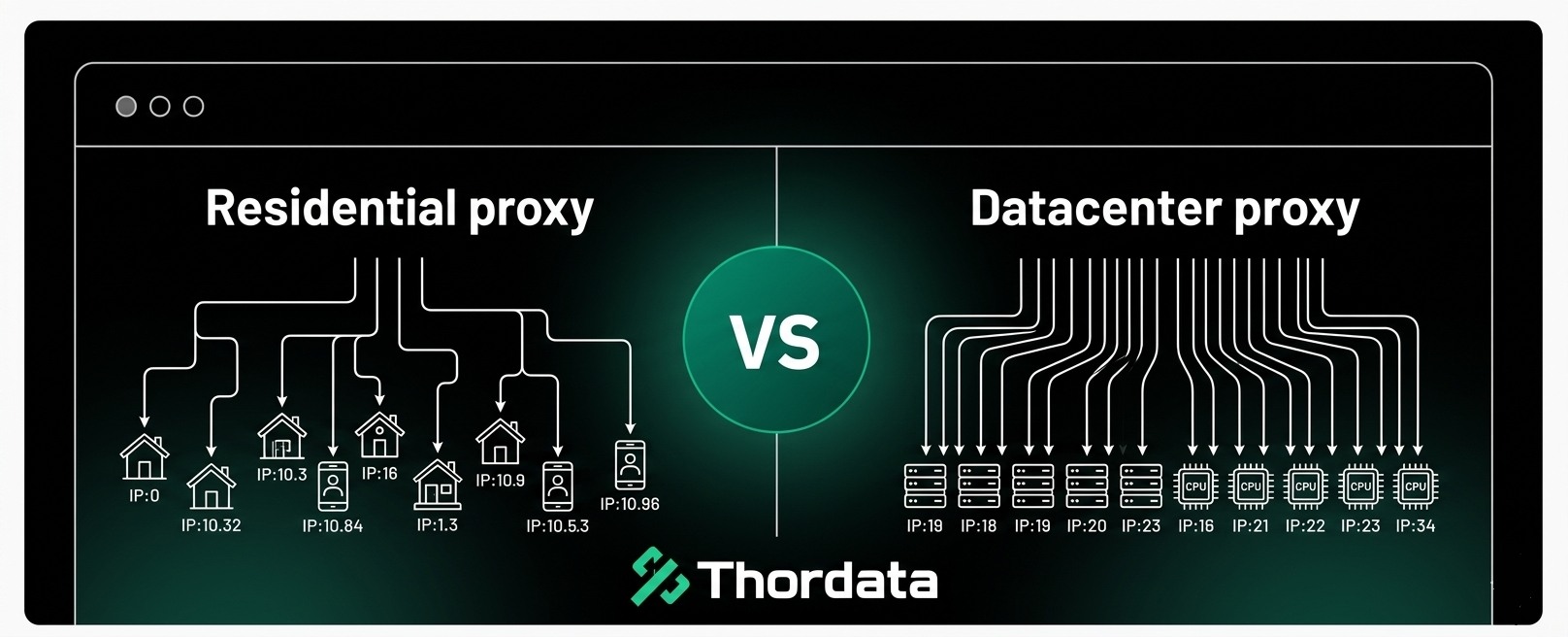
Residential Proxy vs Datacenter Proxy: Which Is the Best Proxy for Web Scraping?
Compare residential proxies an ...
Jenny Avery
2026-06-09
5 Best Fingerprint Browsers for 2026
Fingerprint browsers have beco ...
Xyla Huxley
2026-06-09

Unlimited Residential Proxies: When They Make Sense and How to Choose the Right Plan
Unlimited residential proxies ...
Xyla Huxley
2026-06-08

Residential Proxies for Web Scraping
In this article, we will look ...
Xyla Huxley
2026-06-08