


Web Scraper API
Fetch real-time data from 100+ websites,No development or maintenance required.
SCRAPING SOLUTIONS
Get accurate and in real-time results sourced from Google, Bing, and more.
With 120+ prebuilt and custom scrapers ready for any use case.
No blocks, no CAPTCHAs—unlock websites seamlessly at scale.
Execute scripts in stealth browsers with full rendering and automation
PROXY INFRASTRUCTURE
Over 100 million real residential IPs from genuine users across 190+ countries.
Reliable mobile data extraction, powered by real 4G/5G mobile IPs.
For time-sensitive tasks, utilize residential IPs with unlimited bandwidth.
Fast and cost-efficient IPs optimized for large-scale scraping.
SCRAPING SOLUTIONS
PROXY INFRASTRUCTURE
DATA FEEDS
Full details on all features, parameters, and integrations, with code samples in every major language.
LEARNING HUB
ALL LOCATIONS Proxy Locations
TOOLS
RESELLER
Get up to 50%
Contact sales:partner@thordata.com
Products $/GB
Fetch real-time data from 100+ websites,No development or maintenance required.
Get real-time results from search engines. Only pay for successful responses.
Execute scripts in stealth browsers with full rendering and automation.
Bid farewell to CAPTCHAs and anti-scraping, scrape public sites effortlessly.
Dataset Marketplace Pre-collected data from 100+ domains.
Over 100 million real residential IPs from genuine users across 190+ countries.
Reliable mobile data extraction, powered by real 4G/5G mobile IPs.
For time-sensitive tasks, utilize residential IPs with unlimited bandwidth.
Fast and cost-efficient IPs optimized for large-scale scraping.

Data for AI $/GB
Pricing $0/GB
Docs $/GB
Full details on all features, parameters, and integrations, with code samples in every major language.
Resource $/GB
EN $/GB
产品 $/GB
AI数据 $/GB
定价 $0/GB
产品文档 $/GB
资源 $/GB
简体中文 $/GB

The explosion of large language models has made building AI agents accessible to developers, no-code teams, and even business users. Two open-source platforms dominate this space: Flowise and n8n. Both offer visual, node-based interfaces for orchestrating workflows, but they were built for different primary missions.
Flowise is purpose-built for LLM orchestration and AI agent creation. n8n is a general-purpose automation powerhouse that has added strong AI capabilities over the last two years. This in-depth comparison examines which tool wins when your primary goal is creating production-grade AI agents.
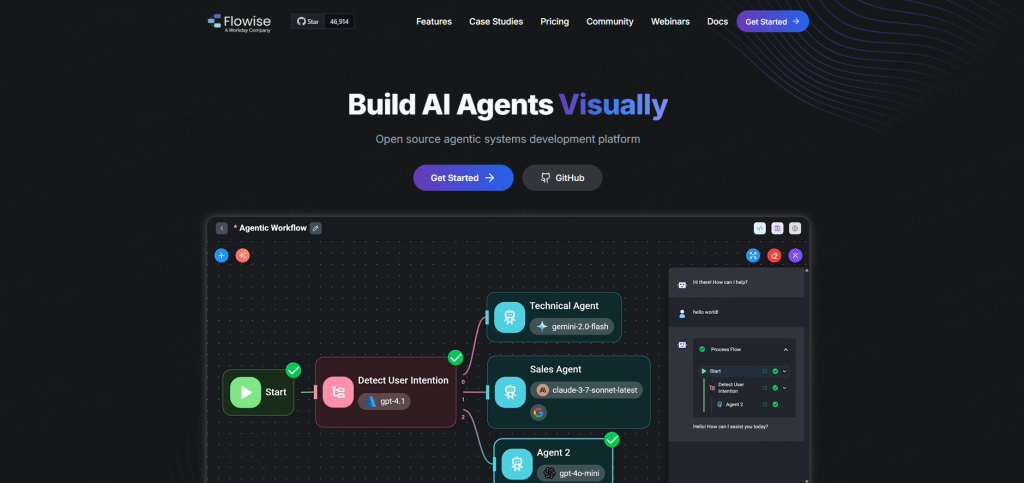
Flowise, released in 2023 by FlowiseAI, is an open-source, low-code platform exclusively tailored for LLM applications. Built on LangChain.js, it enables rapid prototyping of AI agents, retrieval-augmented generation (RAG) systems, chatbots, and multi-agent workflows without deep coding expertise.
Users drag-and-drop components like chains, agents, tools, vector stores, and embeddings onto a canvas. Flowise supports 100+ LLMs (e.g., Grok, Llama, Mistral) and integrates with databases like Pinecone, Weaviate, and Supabase. Its modular architecture allows embedding agents into apps via API, SDKs (React, Next.js), or iframes.
Standout features:
– Canvas-based editor with real-time testing and debugging.
– Self-hosting via Docker or npm.
– Cloud platform launched in 2024 for managed deployments.
– Embeddable UI for white-label solutions.
– Active community: Over 46.9k GitHub stars, 300+ watching.
Flowise proxy integration:
You can configure Flowise to forward all backend requests through a proxy. For this, you can use the `global-agent` package. You can integrate any type of proxy, such as a datacenter proxy for high-speed tasks or a mobile proxy for mobile application testing.
| Flowise Core Stats | Details |
| GitHub Stars | 46.9k+ |
| Integrations | 200+ (AI-focused) |
| License | Apache 2.0 |
| Deployment | Self-host + Cloud |
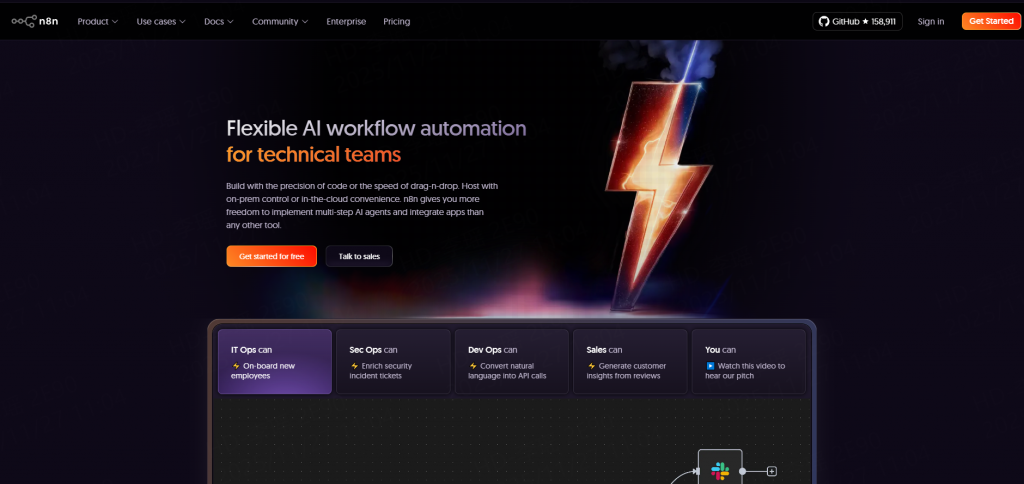
Launched in 2019 by Jan Oberhauser, n8n (pronounced “n-eight-n”) is a fair-code licensed workflow automation platform designed for technical teams. It combines the flexibility of code with the accessibility of visual builders, supporting over 400 native integrations and custom nodes via JavaScript or Python.
At its core, n8n uses a node-based canvas where users connect triggers, actions, and logic blocks to create workflows. It supports cron jobs, webhooks, and event-driven executions. What sets n8n apart for AI agents is its AI Agent node, powered by LangChain integrations, allowing seamless incorporation of LLMs like OpenAI GPT, Anthropic Claude, or local models via Ollama.
Key highlights include:
– Self-hosting on Docker, Kubernetes, or cloud providers.
– Enterprise features like SSO, audit logs, and global variables.
– Cloud version with instant scaling.
– Active community: Over 159k GitHub stars, 900+ watching.
n8n proxy integration:
You can set up a proxy via HTTP request nodes. In most cases, rotating proxies, such as residential proxies, are the best choice because they allow you to access the site with a different user identity each time an HTTP request is made.
n8n powers workflows at companies like Vodafone, Fullscript, and Delivery Hero, automating tasks from lead generation to ETL pipelines with AI-enhanced decisioning.
| n8n Core Stats | Details |
| GitHub Stars | 159k+ |
| Integrations | 400+ |
| Executions/Mo (Cloud) | Unlimited on Pro |
| License | Fair-code (Sustainable Use License) |
Both platforms prioritize visual development, but their interfaces reflect their focuses.
n8n: Features a clean, zoomable canvas with zoom-to-fit, grouping, and sub-workflows. The sidebar offers searchable nodes. It’s intuitive for Zapier users but requires familiarity with automation concepts. Onboarding includes templates and a workflow library.
Flowise: Boasts a simplified drag-and-drop interface optimized for AI chains. Components auto-snap, with inline chat previews for testing. It’s more beginner-friendly for AI novices, with one-click deployments and visual debugging.
Verdict: Flowise wins for pure AI prototyping (9/10 ease), while n8n suits complex automations (8/10).
n8n dominates breadth:
• 400+ apps (Slack, Google Workspace, HubSpot, databases).
• Custom nodes via HTTP, code, or community repo.
Flowise emphasizes AI depth:
• Vector DBs (10+), tools (SerpAPI, Zapier), embeddings (OpenAI, Hugging Face).
• Extends via the LangChain ecosystem.
|
Category |
n8n | Flowise |
| Total Integrations |
400+ |
200+ |
| CRM/Email |
Native (Salesforce, Gmail) |
Via tools |
| AI Models |
50+ via LangChain |
100+ native |
| Custom Code | JS/Python nodes |
JS components |
Verdict: n8n for enterprise integrations; Flowise for AI toolchains.
This is where they shine differently.
n8n: AI Agent node supports ReAct, function calling, and memory. Tools include web scraping, calculators, and custom APIs. Multi-agent via sub-workflows.
Flowise: Advanced AI agent types (conversational, ReAct, OpenAI Functions). Built-in RAG pipelines, multi-agent orchestration, and human-in-the-loop. Supports streaming responses and tool-calling natively.
Benchmarks show Flowise handling complex RAG queries 20% faster in self-hosted setups due to LangChain.js optimization.
Verdict: Flowise leads for sophisticated AI agents.
Both support self-hosting (Docker Compose in minutes), but they approach operational concerns differently. n8n offers a managed cloud as well as an easy self-host path; its product materials emphasize enterprise-ready deployment, role-based access and auditing for workflows. Flowise, being open source, is commonly self-hosted by teams that want control over model endpoints, data residency and the ability to integrate custom models or vector stores behind internal networks. Flowise’s docs and community contributions also show active work on tracing, evaluation and human-in-the-loop patterns to support mature production usage.
Choice here will depend on whether the organization prefers the convenience of a managed platform (n8n) or the flexibility and control of a purpose-built LLM environment
Performance: n8n handles 1M+ tasks/day in production; Flowise excels in low-latency AI inference.
Community: n8n’s forum and Discord; Flowise’s rapid updates via GitHub issues.
Documentation: Both excellent, with n8n edging video tutorials.
Pros:
Vast integrations for hybrid workflows.
Mature enterprise features.
Strong debugging and error handling.
Active roadmap (AI-native nodes in v1.50+).
Cons:
Steeper learning for AI-only users.
License limits SaaS monetization.
Higher resource use for simple agents.
Pros:
AI-first design accelerates development.
Embeddable for apps/products.
Fully open-source.
Superior RAG and multi-agent support.
Cons:
Limited non-AI integrations.
Younger ecosystem (fewer templates).
Cloud is still maturing.
| Aspect | n8n Winner | Flowise Winner |
| Integrations | ✅ | |
| AI Depth | ✅ | |
| Pricing | ✅ | |
| Scalability | ✅ | |
| Ease for Beginners | ✅ |
Building end-to-end automations: E.g., AI-powered lead scoring in HubSpot → Slack alerts → CRM updates.
Enterprise IT: Data syncs with AI anomaly detection.
Hybrid teams: Developers + non-coders.
Example: A logistics firm uses n8n for AI route optimization, integrating Google Maps, weather APIs, and LLMs.
LLM Apps: Custom chatbots, RAG knowledge bases.
Product Embedding: White-label agents in SaaS.
Rapid AI Prototyping: Multi-agent simulations.
Example: An e-learning platform embeds Flowise agents for personalized tutoring with Pinecone vector search.
| Category | Flowise | n8n | Winner for AI Agents |
| Primary Design Focus | LLM orchestration & agents | General automation + AI | Flowise |
| Built-in Agent Types | ReAct, Plan-and-Execute, BabyAGI, AutoGPT, Multi-agent hierarchies, Custom tools | ReAct, Tool-calling, basic chain nodes (via LangChain integration) | Flowise |
| RAG Implementation Speed | 2–5 minutes | 15–30 minutes | Flowise |
| Tool Calling / Function Calling | First-class, visual schema editor | Excellent via OpenAI/Anthropic nodes | Tie |
| Local LLM Support | Ollama, Llama.cpp, LocalAI, GPT4All (excellent) | Ollama, LocalAI (very good) | Flowise (slight edge) |
| Multi-Agent Orchestration | Native hierarchical agents, agent teams | Possible but requires custom JavaScript/code nodes | Flowise |
| Community & Support | Growing – 46.9k+ GitHub stars | Large – 159k+ GitHub stars | n8n |
| Custom Node Development | TypeScript/React – moderate difficulty | TypeScript – extremely mature tooling | n8n |
| Integration | Limited – Focused on AI/LLM systems | Excellent – 400+ integrations | n8n |
n8n is the versatile powerhouse for teams needing broad automation with AI as a feature. It future-proofs operations in data-heavy environments.
Flowise triumphs as the specialized LLM orchestrator, ideal for AI-native products where speed and depth matter most.
For most AI agent builders, Flowise edges out due to its focus, affordability, and explosive growth. Start with self-hosted trials: [n8n]or [Flowise]. Hybrid approaches—using Flowise agents within n8n workflows—are increasingly common.
As AI evolves, both tools commit to open innovation. Monitor updates: n8n’s AI Studio and Flowise’s agentic flows could blur lines further.

Frequently asked questions
How to choose an AI agent framework?
To choose an AI agent framework, evaluate factors such as your project’s specific needs (e.g., LLM focus vs. general automation), ease of integration, scalability, community support, and pricing.
Can n8n and Flowise be used in the same project?
Yes, n8n and Flowise can be used in the same project through hybrid approaches, such as embedding Flowise’s AI agents into n8n’s automation pipelines for enhanced functionality.
About the author
Yulia is a dynamic content manager with extensive experience in social media, project management, and SEO content marketing. She is passionate about exploring new trends in technology and cybersecurity, especially in data privacy and encryption. In her free time, she enjoys relaxing with yoga and trying new dishes.
The thordata Blog offers all its content in its original form and solely for informational intent. We do not offer any guarantees regarding the information found on the thordata Blog or any external sites that it may direct you to. It is essential that you seek legal counsel and thoroughly examine the specific terms of service of any website before engaging in any scraping endeavors, or obtain a scraping permit if required.
 Looking for
Top-Tier Residential Proxies?您在寻找顶级高质量的住宅代理吗?
Looking for
Top-Tier Residential Proxies?您在寻找顶级高质量的住宅代理吗?
How to Scraping Dynamic Websites with Python?
In this article, learn how to ...
Anna Stankevičiūtė
2026-03-03
Scraping Yahoo Finance using Python
Xyla Huxley Last updated on 2026-03-02 10 min read […]
Unknown
2026-03-03
TCP Deep Dive with Wireshark
Xyla Huxley Last updated on 2026-03-03 6 min read TCP i […]
Unknown
2026-03-03
Web Scraping with Python using Requests
Xyla Huxley Last updated on 2026-03-03 6 min read Web c […]
Unknown
2026-03-03
Crawl4AI: Open-Source AI Web Crawler with MCP Automation
Xyla Huxley Last updated on 2026-03-03 10 min read AI a […]
Unknown
2026-03-03
Using Wget with Python: A Practical Guide for Reliable, Scalable Web Data Retrieval
Xyla Huxley Last updated on 2026-03-03 10 min read […]
Unknown
2026-03-03
How to Make HTTP Requests in Node.js With Fetch API (2026)
A practical 2026 guide to usin ...
Kael Odin
2026-03-03

How to Scrape Job Postings in 2026: Complete Guide
A 2026 end-to-end guide to scr ...
Kale Odin
2026-03-03
BeautifulSoup Tutorial 2026: Parse HTML Data With Python
A 2026 step-by-step BeautifulS ...
Kael Odin
2026-03-03
