


Web Scraper API
Fetch real-time data from 100+ websites,No development or maintenance required.
SCRAPING SOLUTIONS
Get accurate and in real-time results sourced from Google, Bing, and more.
With 120+ prebuilt and custom scrapers ready for any use case.
No blocks, no CAPTCHAs—unlock websites seamlessly at scale.
Execute scripts in stealth browsers with full rendering and automation
PROXY INFRASTRUCTURE
Over 100 million real residential IPs from genuine users across 190+ countries.
Reliable mobile data extraction, powered by real 4G/5G mobile IPs.
For time-sensitive tasks, utilize residential IPs with unlimited bandwidth.
Fast and cost-efficient IPs optimized for large-scale scraping.
SCRAPING SOLUTIONS
PROXY INFRASTRUCTURE
DATA FEEDS
Full details on all features, parameters, and integrations, with code samples in every major language.
LEARNING HUB
ALL LOCATIONS Proxy Locations
TOOLS
RESELLER
Get up to 50%
Contact sales:partner@thordata.com
Products $/GB
Fetch real-time data from 100+ websites,No development or maintenance required.
Get real-time results from search engines. Only pay for successful responses.
Execute scripts in stealth browsers with full rendering and automation.
Bid farewell to CAPTCHAs and anti-scraping, scrape public sites effortlessly.
Dataset Marketplace Pre-collected data from 100+ domains.
Over 100 million real residential IPs from genuine users across 190+ countries.
Reliable mobile data extraction, powered by real 4G/5G mobile IPs.
For time-sensitive tasks, utilize residential IPs with unlimited bandwidth.
Fast and cost-efficient IPs optimized for large-scale scraping.

Data for AI $/GB
Pricing $0/GB
Docs $/GB
Full details on all features, parameters, and integrations, with code samples in every major language.
Resource $/GB
EN $/GB
产品 $/GB
AI数据 $/GB
定价 $0/GB
产品文档 $/GB
资源 $/GB
简体中文 $/GB
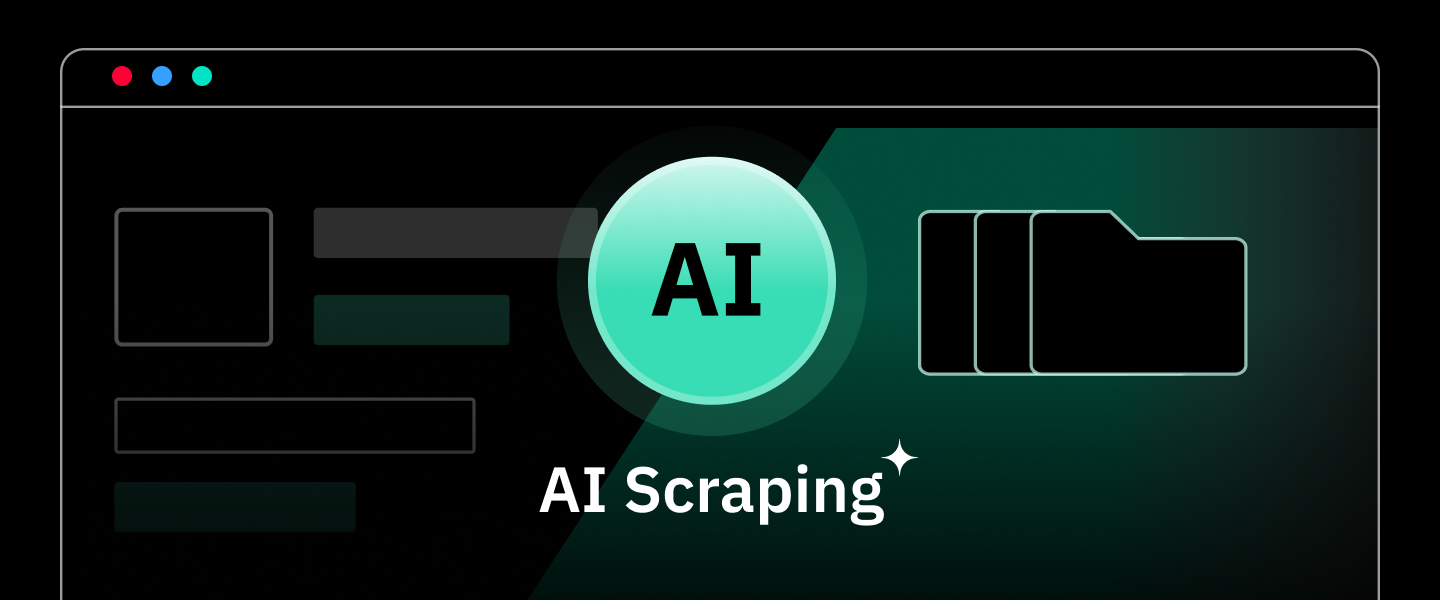

Artificial intelligence has started to reshape how organizations collect and use web data. Traditional web scrapers that rely on rigid rules and CSS selectors still work in many scenarios, but they struggle with today’s dynamic websites, frequent layout changes, and the sheer volume of unstructured content online. In this context, many teams start by asking a simple question: what is AI scraping, and how is it different from ordinary web scraping?
This article explains what AI scraping is, how it works under the hood, where it is most useful, and what limitations and best practices organizations should consider.
AI scraping refers to using automated data extraction, machine learning (ML), and natural language processing (NLP) technologies to collect, interpret, and transform large amounts of online content from websites into structured data.
Rather than treating a web page as a rigid structure to be navigated with static rules, AI scraping interprets the semantics and meaning of information it encounters. It learns to recognize patterns, infer relationships, and adapt to variations in content and layout. As a result, these tools are often more resilient, scalable, and capable of handling both structured and unstructured data—ranging from product listings and tables to free-text articles, reviews, and more.
This fundamental shift—from rule-based extraction to intelligence-driven interpretation—makes AI scraping especially valuable in environments where websites frequently change design, content formats are complex, or unstructured text needs deeper understanding.
AI scraping combines elements of traditional scraping pipelines with advanced AI techniques to deliver more intelligent data extraction. While implementations may vary among providers and tools, most AI scraping systems follow a core set of functional layers:
First, the system still needs to access the target page. This part often resembles classical scraping:
– A crawler or headless browser (such as Playwright, Puppeteer, or Selenium) loads the page.
– Proxies and IP rotation may be used to distribute traffic and reduce blocking.
– JavaScript is executed where necessary to render dynamic content.
At this stage, the output is typically a rendered HTML document and sometimes a DOM snapshot or screenshot.
Next, AI models analyze the page to identify the most relevant areas. Techniques used here can include:
– DOM‑based models that learn which nodes are likely to contain titles, prices, reviews, or other key fields.
– Computer vision models that treat the page like an image, using layout and visual cues.
– NLP models that look at surrounding text to understand context (e.g., whether a number is a price, rating, or quantity).
The aim is to break the page into logical segments—product cards, article bodies, navigation, ads—so that only meaningful content is passed on to the next stage.
Once relevant regions are identified, extraction models convert them into structured data. This can involve:
– Named entity recognition (NER): identifying entities such as product names, brands, locations, or people.
– Field extraction: mapping pieces of text to predefined fields (e.g., `price`, `currency`, `availability`, `category`).
– LLM prompts: asking a language model to “read” the HTML or text and output a JSON object with specific keys and values.
For example, an LLM might be prompted with:
> “Extract the product name, price, currency, rating, and number of reviews from the following HTML. Return a JSON object with keys: `name`, `price`, `currency`, `rating`, `reviews_count`.”
This allows the AI scraper to handle many slightly different page designs without handcrafted selectors for every variation.
Raw extracted data often needs to be cleaned and standardized:
– Converting price strings (like “US$1,299.00”) into numeric values and consistent currencies
-Normalizing categories and units (e.g., “kg” vs “kilogram”)
– Translating content into a target language for multilingual datasets
– Matching entities across sites (e.g., the same product listed on multiple marketplaces)
Machine learning models and rule‑based systems often work together at this stage: models handle ambiguous or varied text, while rules enforce business‑specific constraints.
AI scraping is never perfect on the first attempt. Mature setups therefore include:
– Validation rules (for example, rejecting negative prices or impossible dates)
– Sampling and human review to measure accuracy and detect edge cases
– Active learning loops, where corrected output is fed back to retrain or fine‑tune models
A defining characteristic of AI scraping systems is their ability to learn and adjust over time. Through machine learning algorithms and feedback loops, these tools can detect when a website’s layout has shifted and update their extraction logic accordingly. This adaptability significantly reduces the need for manual rule maintenance, one of the most labor-intensive aspects of traditional scraping projects.
By combining these layers, AI scraping enables a continuous cycle of data collection, interpretation, and refinement that allows organizations to maintain reliable data streams even as web environments evolve.
Although both traditional web scraping and AI scraping aim to extract information from online sources, their methodologies and capabilities are markedly different:
| Feature | Traditional Web Scraping | AI Scraping |
| Rule Dependency | Requires fixed selectors and scripts | Learns patterns, less rule-dependent |
| Adaptability | Breaks when layouts change | Can adjust to new structures |
| Data Types | Works best with structured content | Handles structured and unstructured content |
| Maintenance | Requires frequent manual updates | Self-adjusts with minimal intervention |
| Context Understanding | Limited | Uses NLP and pattern recognition |
| Anti-bot Handling | Often needs external tools | Mimics human behavior and adapts dynamically |
AI scraping can be applied wherever large volumes of online information need to be turned into structured, actionable data. Several use cases stand out in practice.
Organizations use AI scraping to collect comprehensive market data, including product listings, pricing strategies, campaign promotions, and customer feedback. These insights help businesses refine competitive strategies and identify opportunities.
E-commerce enterprises monitor competitors’ pricing in real time and use AI scraping to detect changes, analyze pricing trends, and even inform dynamic pricing models to maintain profitability.
By extracting comments, reviews, social media posts, and blog narratives, companies can understand public sentiment, identify emerging issues, and guide brand positioning efforts.
AI scraping is used to gather economic indicators, stock performance, regulatory filings, and news sources, then feed structured data into analytical models or trading algorithms.
Media organizations and content platforms aggregate large volumes of articles, blog posts, and news reports, categorizing content, identifying trending topics, and summarizing information for editorial workflows.
Researchers extract datasets from academic journals, databases, public records, and repositories to conduct large-scale empirical studies or machine learning model training with contextual accuracy.
Despite its advantages, AI scraping is not a universal solution, and it introduces new complexities that organizations should understand.
Running large language models or other deep learning systems is more resource‑intensive than simple HTML parsing. The costs may include:
• GPU or high‑performance CPU resources
• Latency overhead for model inference
• Storage and bandwidth for larger volumes of processed data
Teams often need to balance accuracy against cost, using lighter‑weight models for routine tasks and reserving heavier models for the hardest cases.
AI extraction can fail in subtle ways—mislabeling a field, confusing similar entities, or “hallucinating” information that is not actually present. Unlike a broken CSS selector, these errors may not be immediately obvious.
Robust deployments therefore require:
• Clear evaluation metrics (precision, recall, and error types)
• Regular sampling and manual review of output
• Mechanisms to correct and retrain models when issues are found
Without this oversight, AI scraping can produce data that looks plausible but is unreliable.
Any scraping—AI‑based or otherwise—must respect:
• Website terms of service and robots.txt directives where applicable
• Rate limits and technical protections against abuse
• Data protection regulations (such as GDPR, CCPA) when personal data is involved
• Sector‑specific rules (for example, in finance or healthcare)
AI does not override these constraints. In fact, because AI scraping can operate at large scale, governance and compliance become even more important.
Organizations interested in AI scraping can benefit from a structured approach rather than rushing straight into experimentation.
Defining a narrow, high-value use case helps:
• Identify which data fields truly matter
• Decide which sites or domains to prioritize
• Choose appropriate models and evaluation criteria
For example, focusing first on price and stock information for a specific product category is more manageable than scraping “all competitor data.”
AI scraping works best when combined with simpler techniques:
• Use deterministic rules for straightforward fields (e.g., obvious IDs or URLs).
• Apply AI to ambiguous or unstructured parts of the page.
• Add post‑processing rules for validation (e.g., price ranges, date formats).
This hybrid approach keeps the system efficient and easier to reason about.
Effective AI scrapers learn from their mistakes. Teams can:
• Log extracted results and highlight low‑confidence cases
• Provide annotation tools for reviewers to correct data
• Periodically retrain or fine‑tune models with the corrected examples
Over time, this iterative process improves accuracy on the domains that matter most.
Some organizations have the data science resources to build AI scraping pipelines in‑house. Others may prefer specialized platforms or APIs that already integrate crawling, proxies, and AI models.
Thordata Web Scraper API provides the dependable data collection layer needed for bulk AI scraping. It fetches and renders large volumes of URLs (including JavaScript‑heavy pages), manages rotating proxies and retries, and returns clean HTML or structured responses that can be fed directly into AI or LLM pipelines. This lets teams skip building their own crawling and proxy infrastructure and focus on the AI models that extract and analyze the data.
AI scraping elevates web data extraction by combining automation with contextual understanding and adaptability. Its ability to process structured and unstructured content, self-adjust to site changes, and extract richer insights makes it an indispensable tool across business intelligence, research, e-commerce, finance, and beyond. As AI technologies mature, so too will the strategic value of AI scraping. If you have any questions, feel free to contact us at support@thordata.com.

Frequently asked questions
What is AI web scraping?
AI web scraping uses artificial intelligence (like machine learning and large language models) to extract structured data from websites. Instead of relying only on fixed CSS/XPath selectors, AI can understand page content, adapt to layout changes, and pull out fields (prices, names, reviews, etc.) more flexibly.
How to use AI for web scraping?
In practice, you:
1. Use a crawler or Web Scraper API to fetch and render pages.
2. Feed the HTML or text into an AI model (e.g., an LLM or NLP pipeline).
3. Ask the model to extract specific fields and return them in a structured format (JSON, CSV).
Always respect target sites’ terms of service, robots.txt, and legal requirements.
What does AI scraping mean?
AI scraping means using AI techniques to collect and interpret data from web pages. Instead of just downloading HTML, AI scraping “reads” the content, identifies what matters (like products, companies, or key facts), and turns it into clean, usable data.
Is Google Docs scraping for AI?
Google Docs content is not “web scraped” like public websites. By default, Docs are private and only accessible to you and people you share them with.
About the author
Yulia is a dynamic content manager with extensive experience in social media, project management, and SEO content marketing. She is passionate about exploring new trends in technology and cybersecurity, especially in data privacy and encryption. In her free time, she enjoys relaxing with yoga and trying new dishes.
The thordata Blog offers all its content in its original form and solely for informational intent. We do not offer any guarantees regarding the information found on the thordata Blog or any external sites that it may direct you to. It is essential that you seek legal counsel and thoroughly examine the specific terms of service of any website before engaging in any scraping endeavors, or obtain a scraping permit if required.
 Looking for
Top-Tier Residential Proxies?您在寻找顶级高质量的住宅代理吗?
Looking for
Top-Tier Residential Proxies?您在寻找顶级高质量的住宅代理吗?
How to Scraping Dynamic Websites with Python?
In this article, learn how to ...
Anna Stankevičiūtė
2026-03-03
Scraping Yahoo Finance using Python
Xyla Huxley Last updated on 2026-03-02 10 min read […]
Unknown
2026-03-03
TCP Deep Dive with Wireshark
Xyla Huxley Last updated on 2026-03-03 6 min read TCP i […]
Unknown
2026-03-03
Web Scraping with Python using Requests
Xyla Huxley Last updated on 2026-03-03 6 min read Web c […]
Unknown
2026-03-03
Crawl4AI: Open-Source AI Web Crawler with MCP Automation
Xyla Huxley Last updated on 2026-03-03 10 min read AI a […]
Unknown
2026-03-03
Using Wget with Python: A Practical Guide for Reliable, Scalable Web Data Retrieval
Xyla Huxley Last updated on 2026-03-03 10 min read […]
Unknown
2026-03-03
How to Make HTTP Requests in Node.js With Fetch API (2026)
A practical 2026 guide to usin ...
Kael Odin
2026-03-03
How to Scrape Job Postings in 2026: Complete Guide
A 2026 end-to-end guide to scr ...
Kale Odin
2026-03-03
BeautifulSoup Tutorial 2026: Parse HTML Data With Python
A 2026 step-by-step BeautifulS ...
Kael Odin
2026-03-03
