


Web Scraper API
Fetch real-time data from 100+ websites,No development or maintenance required.
SCRAPING SOLUTIONS
Get accurate and in real-time results sourced from Google, Bing, and more.
With 120+ prebuilt and custom scrapers ready for any use case.
No blocks, no CAPTCHAs—unlock websites seamlessly at scale.
Execute scripts in stealth browsers with full rendering and automation
PROXY INFRASTRUCTURE
Over 100 million real residential IPs from genuine users across 190+ countries.
Reliable mobile data extraction, powered by real 4G/5G mobile IPs.
For time-sensitive tasks, utilize residential IPs with unlimited bandwidth.
Fast and cost-efficient IPs optimized for large-scale scraping.
SCRAPING SOLUTIONS
PROXY INFRASTRUCTURE
DATA FEEDS
Full details on all features, parameters, and integrations, with code samples in every major language.
LEARNING HUB
ALL LOCATIONS Proxy Locations
TOOLS
RESELLER
Get up to 50%
Contact sales:partner@thordata.com
Products $/GB
Fetch real-time data from 100+ websites,No development or maintenance required.
Get real-time results from search engines. Only pay for successful responses.
Execute scripts in stealth browsers with full rendering and automation.
Bid farewell to CAPTCHAs and anti-scraping, scrape public sites effortlessly.
Dataset Marketplace Pre-collected data from 100+ domains.
Over 100 million real residential IPs from genuine users across 190+ countries.
Reliable mobile data extraction, powered by real 4G/5G mobile IPs.
For time-sensitive tasks, utilize residential IPs with unlimited bandwidth.
Fast and cost-efficient IPs optimized for large-scale scraping.

Data for AI $/GB
Pricing $0/GB
Docs $/GB
Full details on all features, parameters, and integrations, with code samples in every major language.
Resource $/GB
EN $/GB
产品 $/GB
AI数据 $/GB
定价 $0/GB
产品文档 $/GB
资源 $/GB
简体中文 $/GB

Your subtitle operation runs like plumbing: source files in, translations out, turnaround in days, cost per minute of video in cents. Your dubbing ambition — synthetic voices matching speaker energy, or even human dubbing at scale — keeps stalling in evaluation, and the reason is consistent across every stalled program we’ve reviewed: the training and evaluation data for speech translation and voice style exists only as an afterthought. Subtitle files are cheap. Dubbing data isn’t. This memo is the gap analysis and the sourcing plan.
Subtitles are text-in, text-out. Dubbing is text-in, *speech* out, which means the data layer needs three things subtitle pipelines never touch:
| Dubbing requirement | What subtitle data provides | What it actually needs |
|---|---|---|
| Translation quality with spoken register | Written translations, often condensed | Translations preserving spoken rhythm, fillers, speaker turns |
| Voice style reference | Nothing | Source audio with speaker characteristics intact |
| Timing alignment | Frame-level cue timing | Utterance-level alignment between source speech and target text |
| Evaluation pairs | None | Same content, multiple languages, audio + text aligned |
The pattern that stalls programs: teams discover requirement by requirement, mid-project, each one a new data hunt. The memo’s purpose is to front-load all four.
The strongest signal from programs that shipped: the best dubbing training data is *naturally occurring parallel media* — the same or comparable content existing in multiple languages with audio and text aligned. Where does that exist at scale? Video platforms, where creators dub their own content across markets, where official channels publish localized versions, and where caption tracks in multiple languages attach to the same video.
This is precisely the shape of a modern video dataset. Thordata’s video dataset — 6 billion original videos from 700 million unique channels, delivered as structured records in JSON, CSV, or Parquet — carries per-record caption/transcript fields, audio-language metadata, and channel lineage. Filtered for multi-language markets and caption presence, it functions as a weakly-supervised parallel corpus: the join between source-market and target-market records is the channel and title metadata, and the audio is in the file. At roughly $0.25 per 1,000 records, the acquisition cost of a serious speech-translation corpus is a few hundred dollars — the expensive part of dubbing programs was never the corpus; it’s the quarters spent discovering you needed one.
Phase 1 — parallel pair harvest (weeks 1–3). License a filtered video-dataset shard: high-caption-coverage records across your launch languages, channel-diverse to avoid one creator’s style becoming your voice model’s prior. Extract aligned pairs: source audio, source transcript, target-market caption.
Phase 2 — style reference set (parallel). For voice characteristics, assemble a narrow, rights-clean reference set of target-language speech — either licensed through the dataset vendor’s custom scoping or recorded in-house. Keep it small and documented; this is the set your legal team will ask about first.
Phase 3 — evaluation suite (before any model work). Same sourcing discipline as training, different path: a holdout of real launch-market content, scored by native speakers, stratified by content type (dialogue, narration, tutorial). A dubbing program without a native-scored holdout is navigating by vibes.
Phase 4 — the demand-side check. Before committing the launch slate, validate what your markets actually watch and search for. Localization ROI is decided by discovery: which dubbed titles surface in market search. A SERP monitoring solution — structured, geo-pinned results at about $0.70 per 1,000 responses — tells you which localized queries your catalog wins or loses in each market, which is the difference between dubbing what you *can* and dubbing what will *travel*.
| Line | Rough cost |
|---|---|
| Parallel corpus (filtered shard) | Low hundreds of dollars, one-time |
| Style reference set | Recording/licensing, one-time |
| Evaluation suite assembly + native scoring | The real cost — budget it like QA |
| Market discovery feed (SERP data) | Hundreds per month at launch scale |
The asymmetry to note for whoever approves this: the corpus is the cheapest line and unblocks everything else. Programs that approved the model and deferred the data spent the same money later, at crisis pricing, on a worse corpus assembled under deadline.
Why not use open speech-translation datasets?
Use them for prototyping, not for shipping. They’re well-studied, mostly European Parliament and news-reading registers — which is exactly why dubbing models trained on them sound like newscasters reading a phone menu. Spontaneous, creator-register speech across markets is what commercial video corpora add.
Synthetic voices or human dubbing — does the data plan change?
The corpus plan doesn’t change; the style reference set does. Synthetic pipelines need more style data but no studio time; human pipelines need less model data but the parallel corpus still drives translation and timing. Both need the evaluation suite — the holdout is plan-independent.
How do we handle languages with thin creator ecosystems?
That’s what custom collection is for: the vendor’s collection infrastructure (residential IPs across 190+ countries, city-level targeting, $0.65–$2.00/GB published rates) can run targeted collection for thin languages the corpus under-covers. Budget it as a follow-on, scoped after Phase 1 shows exactly where the gaps are.
What does the market-discovery feed actually change?
Launch order. Every localization team has more content than budget; the continuous SERP data crawling feed ranks markets by demonstrated search demand for your genre — so the dubbing budget follows evidence instead of instinct. One quarter of feed data typically reorders a launch slate; whether that reorder pays for the feed is the easiest ROI calculation in this memo.
Bottom line? Approve the corpus and the evaluation suite now; they’re cheap, they’re the critical path, and every stalled dubbing program we’ve examined stalled on one of those two. Defer the voice-style decisions until Phase 1 lands, and let the demand-side feed — through SERP monitoring — pick which titles go first. The subtitle pipeline will keep running either way; this memo is about the next one not stalling.
 Looking for
Top-Tier Residential Proxies?您在寻找顶级高质量的住宅代理吗?
Looking for
Top-Tier Residential Proxies?您在寻找顶级高质量的住宅代理吗?
Screenshots, Charts, and Scanned PDFs: The Document Mess No Model Was Trained For
Enterprise text extraction qui ...
Xyla Huxley
2026-10-08

The Pricing Page Changed on a Tuesday: B2B Signals Hiding on Your Prospects’ Websites
The best buying signals in B2B aren’t in your CRM […]
Unknown
2026-10-08

Website Change Monitoring with Proxies: How to Reduce False Alerts
Learn how to build a reliable ...
Jenny Avery
2026-09-30

Proxy Rotation Strategy for Web Scraping: When to Rotate IPs and When to Keep a Session
Build a practical proxy rotati ...
Jenny Avery
2026-09-24

How to Scrape Amazon Product Data for Price and Availability Monitoring
Learn how to build an Amazon p ...
Jenny Avery
2026-09-24
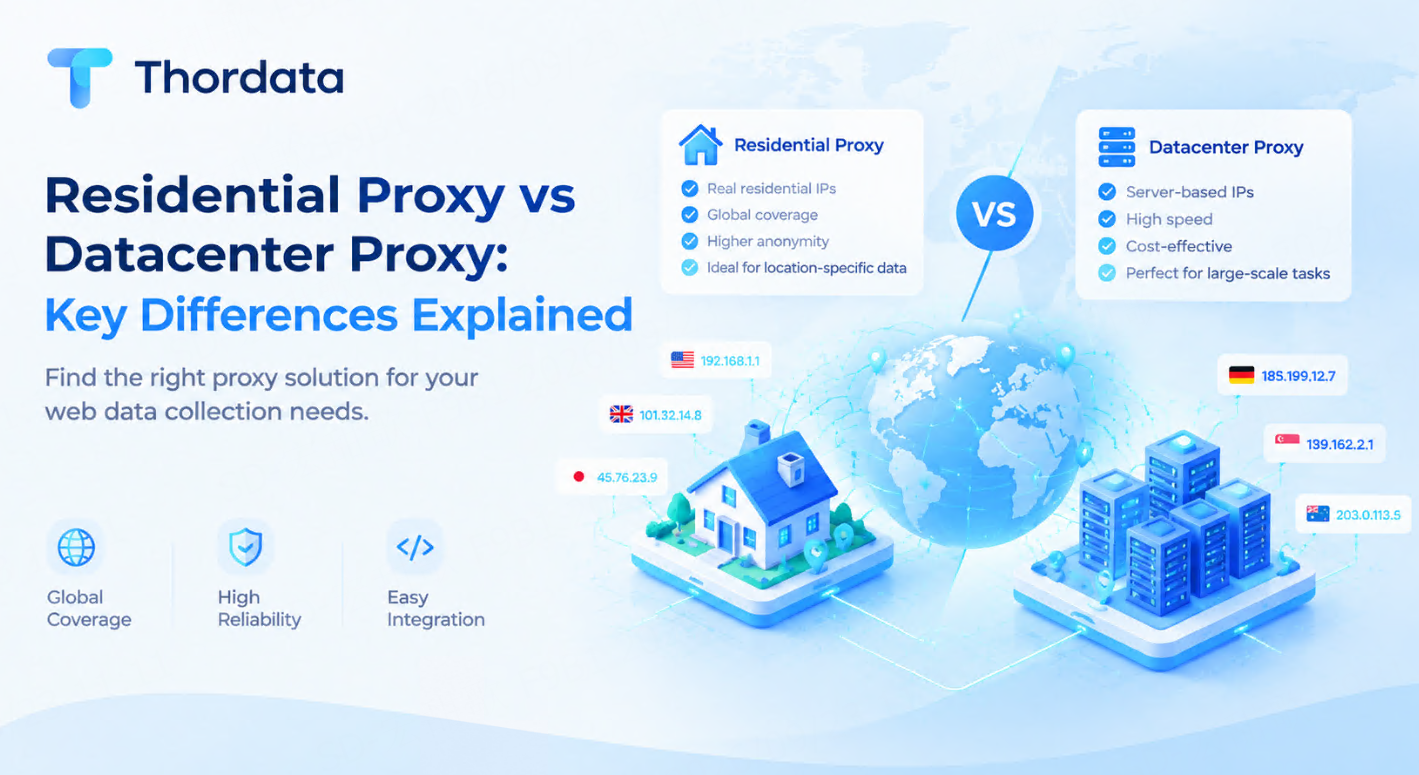
Residential Proxy vs Datacenter Proxy: Key Differences Explained
Learn the differences between ...
flora
2026-09-23

同一份工作負載,三種公司規模:Decodo 與 Thordata 的分階段計價
「哪個抓取平台更便宜」是錯的問題,因為答案隨成長而變。
Xyla Huxley
2026-09-22

行動 IP 是另一種產品:4G/5G、住宅與資料中心的訊號報告
買代理的人把「住宅」與「行動」當成同一種東西的兩個價格帶。
Xyla Huxley
2026-09-22
直接抄走這份設計文件:不會過時的影片推薦訓練資料
多數影片推薦系統的衰退,不是模型錯了,而是訓練資料凍住了—— ...
Xyla Huxley
2026-09-22