


Web Scraper API
Fetch real-time data from 100+ websites,No development or maintenance required.
SCRAPING SOLUTIONS
Get accurate and in real-time results sourced from Google, Bing, and more.
With 120+ prebuilt and custom scrapers ready for any use case.
No blocks, no CAPTCHAs—unlock websites seamlessly at scale.
Execute scripts in stealth browsers with full rendering and automation
PROXY INFRASTRUCTURE
Over 100 million real residential IPs from genuine users across 190+ countries.
Reliable mobile data extraction, powered by real 4G/5G mobile IPs.
For time-sensitive tasks, utilize residential IPs with unlimited bandwidth.
Fast and cost-efficient IPs optimized for large-scale scraping.
SCRAPING SOLUTIONS
PROXY INFRASTRUCTURE
DATA FEEDS
Full details on all features, parameters, and integrations, with code samples in every major language.
LEARNING HUB
ALL LOCATIONS Proxy Locations
TOOLS
RESELLER
Get up to 50%
Contact sales:partner@thordata.com
Products $/GB
Fetch real-time data from 100+ websites,No development or maintenance required.
Get real-time results from search engines. Only pay for successful responses.
Execute scripts in stealth browsers with full rendering and automation.
Bid farewell to CAPTCHAs and anti-scraping, scrape public sites effortlessly.
Dataset Marketplace Pre-collected data from 100+ domains.
Over 100 million real residential IPs from genuine users across 190+ countries.
Reliable mobile data extraction, powered by real 4G/5G mobile IPs.
For time-sensitive tasks, utilize residential IPs with unlimited bandwidth.
Fast and cost-efficient IPs optimized for large-scale scraping.

Data for AI $/GB
Pricing $0/GB
Docs $/GB
Full details on all features, parameters, and integrations, with code samples in every major language.
Resource $/GB
EN $/GB
产品 $/GB
AI数据 $/GB
定价 $0/GB
产品文档 $/GB
资源 $/GB
简体中文 $/GB

“Which scraping platform is cheaper” is the wrong question because the answer changes as you grow. The right question is “which pricing model matches my current stage” — and the honest answer is that subscription tiers and per-result pricing each win at different volumes. This piece prices one concrete workload — a brand-monitoring collection job — at a 5-person startup, a 40-person scale-up, and a mature 200-person company, on both Decodo and Thordata at published rates. No vendor loses; each model has its stage.
The workload, held constant across all three stages so the pricing is comparable: collect brand and product mentions across major marketplaces and review platforms, track 10,000 keywords in search daily, and sweep 200 long-tail sites weekly. What changes between stages is scale — 10×, 100× — and how much engineering the team can point at collection.
At this volume, the numbers are small and the deciding factors aren’t price.
| Line | Decodo | Thordata |
|---|---|---|
| Marketplace/review scraping | Scraping API $19/mo tier, free starter plan available | ~$10/mo at $1.00 per 1,000 results |
| SERP tracking (60K responses/mo) | Fast Search API — custom pricing via sales | ~$72/mo at $1.20 per 1,000 responses |
| Long-tail sites | Included in Scraping API templates where covered | Residential slider: ~$6/mo at 3 GB |
| Roughly | $19+/mo plus a sales conversation for SERP | ~$90/mo, all self-serve |
The honest read: Decodo’s free starter plan and $19 tier are the friendliest possible entry — genuinely free prototyping, subscription predictability, and a polished dashboard for a team with no collection engineering. The catch at this stage is the SERP line: Decodo’s Fast Search API is sales-led with custom pricing, which for a 5-person startup means a procurement conversation mid-build. Thordata’s everything-self-serve model costs more at tiny volumes but has no conversation anywhere. Startup verdict: Decodo if marketplace scraping dominates and SERP can wait; Thordata if search visibility is part of the product from day one.
Ten-fold growth is where the pricing models start to diverge materially.
| Line | Decodo | Thordata |
|---|---|---|
| Marketplace/review scraping | $49–$99/mo tiers cover ~this range | ~$500–1,000/mo at $0.50–1.00 per 1,000 results |
| SERP tracking (18M responses/mo) | Fast Search API custom pricing | ~$12,600/mo at $0.70 per 1,000 responses |
| Long-tail sites | Subscription-adjacent; heavier use pushes tier upgrades | ~$150/mo at 150 GB residential (~$1.00/GB region) |
The honest read: this stage has two realities. First, Decodo’s subscription tiers remain excellent for bounded, predictable marketplace workloads — $99/month for a stable scraping volume is easy budgeting, and its 100+ templates cover the major platforms well. Second, the SERP line at scale is where subscription models either force a custom enterprise conversation (as Decodo’s Fast Search API does by design) or per-response pricing simply scales linearly. Thordata’s per-result and per-response pricing at this stage is volume-discounted automatically — the published rates step from $1.00 to about $0.50 per 1,000 results as volume grows, with no renegotiation event. Scale-up verdict: both are defensible; the divergence is whether your SERP volume is a product line (per-response pricing wins) or a nice-to-have (subscription plus a sales call is fine).
At 200 people, the question stops being “which vendor” and becomes “how do we structure provider risk.”
| Consideration | Decodo | Thordata |
|---|---|---|
| Volume pricing | Enterprise conversation at this scale | Published slider continues: $0.50/1K results, $0.70/1K SERP responses, residential to $0.65/GB |
| Procurement motion | Account-managed, subscription-based | Self-serve, usage-based, volume-tiered |
| Natural role in a multi-vendor stack | The predictable-baseline provider on subscription pricing | The elastic-overflow provider on per-unit pricing |
The honest read: mature teams increasingly run both models deliberately — a subscription-billed baseline with one provider for budgetability, and per-unit capacity with another for bursts, campaigns, and growth, behind a retry-aware router. Decodo fits the first role well; Thordata’s published per-unit economics fit the second. This isn’t indecision — multi-vendor is a risk posture, and the pricing models complement rather than compete at this stage.
Three rules fell out of pricing the same workload three ways:
Is this saying Decodo is only for small teams?
No — it’s saying subscription pricing is most valuable at small, predictable volumes, and Decodo executes that model well. Stable marketplace-scraping workloads at mid-scale are also a good fit. The stage analysis is about pricing models, and both models have stages where they’re the rational choice.
What about reliability differences?
Both vendors publish uptime in the 99.9% range and both offer trials — Decodo a 3-day/100MB trial, Thordata free trial credits on its scraper and SERP APIs plus a residential trial. As with any provider comparison, your own ten hardest targets for one week is the only benchmark that counts; both trials make that free.
We’re between stages — which do we pick?
Price your actual workload on both models at your current volume and at 2× your current volume. If the 2× number changes your vendor choice, pick the per-unit model now and skip the migration later. If both numbers are comfortable, pick the workflow you prefer — dashboard and subscription (Decodo) versus API-first and usage-based (Thordata).
Where does the SERP workload fit in the staged plan?
Everywhere, and it’s the easiest line to pilot: the continuous SERP data crawling service runs on free trial credits for a first evaluation, prices per structured response at every stage, and — because rank monitoring is the workload every stakeholder can define in one sentence — it’s the cleanest A/B test of per-unit pricing against whatever your current provider charges for the same data.
The one-sentence summary: pick the pricing model that matches your stage, not the vendor that wins a single quote — because the same workload, priced at 10× and 100× scale, is what reveals which model grows with you and which one you’ll outgrow.
 Looking for
Top-Tier Residential Proxies?您在寻找顶级高质量的住宅代理吗?

Proxy Rotation Strategy for Web Scraping: When to Rotate IPs and When to Keep a Session
Build a practical proxy rotati ...
Jenny Avery
2026-09-24

How to Scrape Amazon Product Data for Price and Availability Monitoring
Learn how to build an Amazon p ...
Jenny Avery
2026-09-24
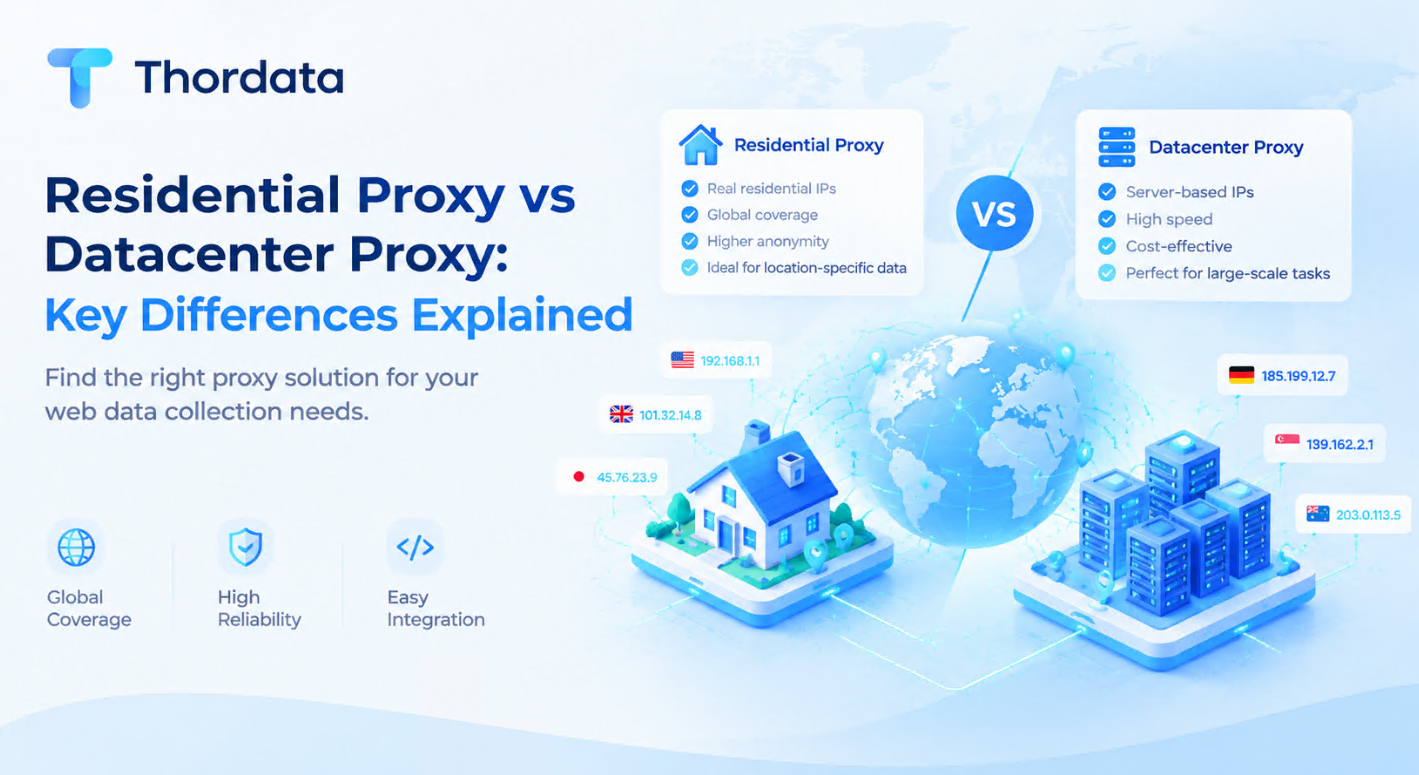
Residential Proxy vs Datacenter Proxy: Key Differences Explained
Learn the differences between ...
flora
2026-09-23

同一份工作負載,三種公司規模:Decodo 與 Thordata 的分階段計價
「哪個抓取平台更便宜」是錯的問題,因為答案隨成長而變。
Xyla Huxley
2026-09-22

行動 IP 是另一種產品:4G/5G、住宅與資料中心的訊號報告
買代理的人把「住宅」與「行動」當成同一種東西的兩個價格帶。
Xyla Huxley
2026-09-22

直接抄走這份設計文件:不會過時的影片推薦訓練資料
多數影片推薦系統的衰退,不是模型錯了,而是訓練資料凍住了—— ...
Xyla Huxley
2026-09-22

為什麼你的商品 Feed 永遠對不上供應商的:一份現場診斷
目錄錯配——同一個商品以三筆不同紀錄存在於你的 Feed、供 ...
Xyla Huxley
2026-09-22

90 秒完售:搶購監控團隊在倒數開始前就做錯的事
限量發售——球鞋、主機補貨、演唱會門票——是電商裡最惡劣的資 ...
Xyla Huxley
2026-09-22

Mobile IPs Are a Different Product: A Signal Report on 4G/5G vs. Residential vs. Datacenter
Proxy buyers treat "residentia ...
Xyla Huxley
2026-09-21