


Web Scraper API
Fetch real-time data from 100+ websites,No development or maintenance required.
SCRAPING SOLUTIONS
Get accurate and in real-time results sourced from Google, Bing, and more.
With 120+ prebuilt and custom scrapers ready for any use case.
No blocks, no CAPTCHAs—unlock websites seamlessly at scale.
Execute scripts in stealth browsers with full rendering and automation
PROXY INFRASTRUCTURE
Over 100 million real residential IPs from genuine users across 190+ countries.
Reliable mobile data extraction, powered by real 4G/5G mobile IPs.
For time-sensitive tasks, utilize residential IPs with unlimited bandwidth.
Fast and cost-efficient IPs optimized for large-scale scraping.
SCRAPING SOLUTIONS
PROXY INFRASTRUCTURE
DATA FEEDS
Full details on all features, parameters, and integrations, with code samples in every major language.
LEARNING HUB
ALL LOCATIONS Proxy Locations
TOOLS
RESELLER
Get up to 50%
Contact sales:partner@thordata.com
Products $/GB
Fetch real-time data from 100+ websites,No development or maintenance required.
Get real-time results from search engines. Only pay for successful responses.
Execute scripts in stealth browsers with full rendering and automation.
Bid farewell to CAPTCHAs and anti-scraping, scrape public sites effortlessly.
Dataset Marketplace Pre-collected data from 100+ domains.
Over 100 million real residential IPs from genuine users across 190+ countries.
Reliable mobile data extraction, powered by real 4G/5G mobile IPs.
For time-sensitive tasks, utilize residential IPs with unlimited bandwidth.
Fast and cost-efficient IPs optimized for large-scale scraping.

Data for AI $/GB
Pricing $0/GB
Docs $/GB
Full details on all features, parameters, and integrations, with code samples in every major language.
Resource $/GB
EN $/GB
产品 $/GB
AI数据 $/GB
定价 $0/GB
产品文档 $/GB
资源 $/GB
简体中文 $/GB


Whether you’be involved in e-commerce data collection, social media account management, global SEO monitoring, or email marketing, choosing the right reseller is crucial.
The right choice means stability, efficiency, and low blocking rates; the wrong choice can lead to increased costs, data corruption, and a significantly higher risk of blocking. If you’re looking to buy residential proxies, you’ve come to the right place. Let’s delve deeper.
In this review, we conducted a comprehensive evaluation of eight leading service providers—Thordata, Oxylabs, Bright Data,SOAX, NetNut, IPRoyal, Webshare, and Decodo—across four key dimensions: features (product types and capabilities), pricing and plans, target user groups, and strengths/weaknesses. Each product was tested for at least 120 days. Finally, we offered practical suggestions for your business (considering your role in the proxy industry) and explained how to better position your product.
| Provider | Pool Size | Locations | Price | Success Rate | Coupon | Free Trial |
| 60M+ | 190+ | $3.5/GB | 99.82% | Use THORDATA666 to get 30% OFF | ✅ | |
| Oxylabs | 175M+ | 190+ | $4/GB | 99.82% | ❌ | ✅ |
|
Brightdata |
150M+ | 195+ | $4/GB | 99.95% | ❌ | ✅ |
| IPRoyal | 34M+ | 195+ | $3.5/GB | 99% | ❌ | ❌ |
| SOAX | 155M+ | 195+ | $3.6/GB | 99.95% | ❌ | ❌ |
| NetNut | 85M+ | 195+ | $3.53/GB | 98.40% | ❌ | ✅ |
| Webshare | 30M+ | 195+ | $3.5 / GB | 99.58% | ❌ | ❌ |
| Decodo | 125M+ | 195+ | $3.5/GB | 99.86% | ❌ | ✅ |
Get 30% Off Residential Proxy plans!
Use discount code THORDATA666 on your first purchase.
Claim 30% OFF
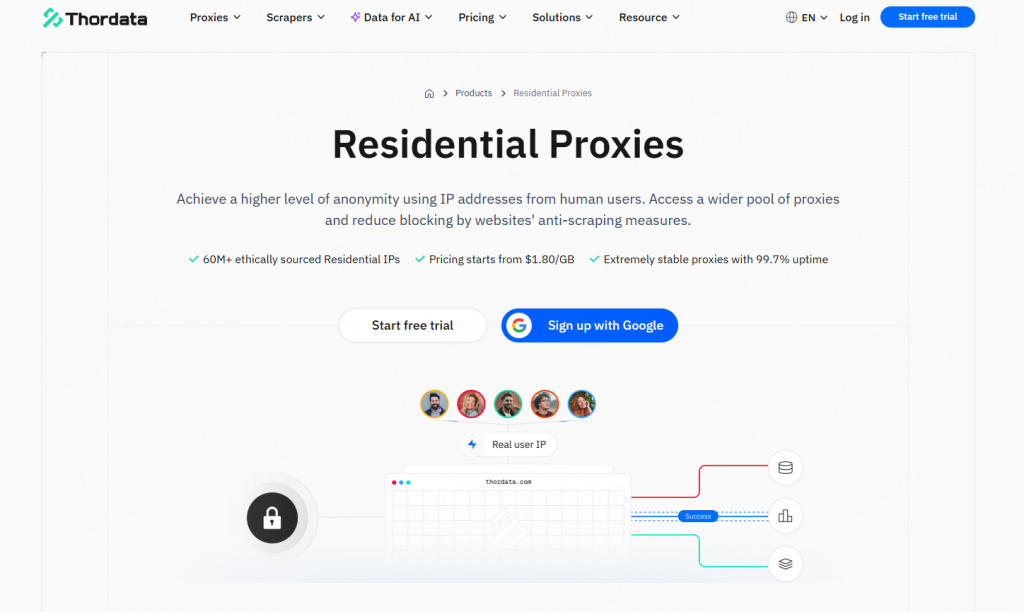
• Its residential pool is branded as 60M+ real residential IPs, coverage across 190+ countries, claiming <0.5s response time and 99.82%+ uptime.
• Geo-targeting options include country, city, state, ISP/ASN filters.
• Supports HTTP(S) & offers an easy dashboard and Chrome extension for management.
• Offers both rotating and sticky session options for residential proxies.
• Residential proxy servers start at $3.50/GB. Trial or promotional prices starting at “$0.65/GB,” with pay-as-you-go support.
• They also offer a complete list of tiered packages, and promotional materials emphasize “flexible rotation options” and a self-service control panel.
• Ideal for teams needing large-scale residential proxy usage, global multi-region coverage, for tasks like web scraping, AI data collection, brand monitoring, and social media account operations.
Strengths:
• Very competitive pricing in the residential proxy market, Strong value proposition witha large IP pool + global geographic spread.
• Advanced features, strong infrastructure, and enterprise mentality.
• Developer-friendly, good for scaling.
Weaknesses:
• Although Thordata is relatively new to the market, its focus is entirely on the future, bringing a modern and agile approach that resonates with today’s needs.
For the residential proxy niche, Thordata stands out as a high-value residential proxy choice, especially suited for large‑scale data tasks where cost‑effectiveness and global coverage matter. Of course, Thordata ensures that its products meet high-end standards while maintaining excellent cost-effectiveness.
Get 30% Off Residential Proxy plans!
Use discount code THORDATA666 on your first purchase.
Claim 30% OFF
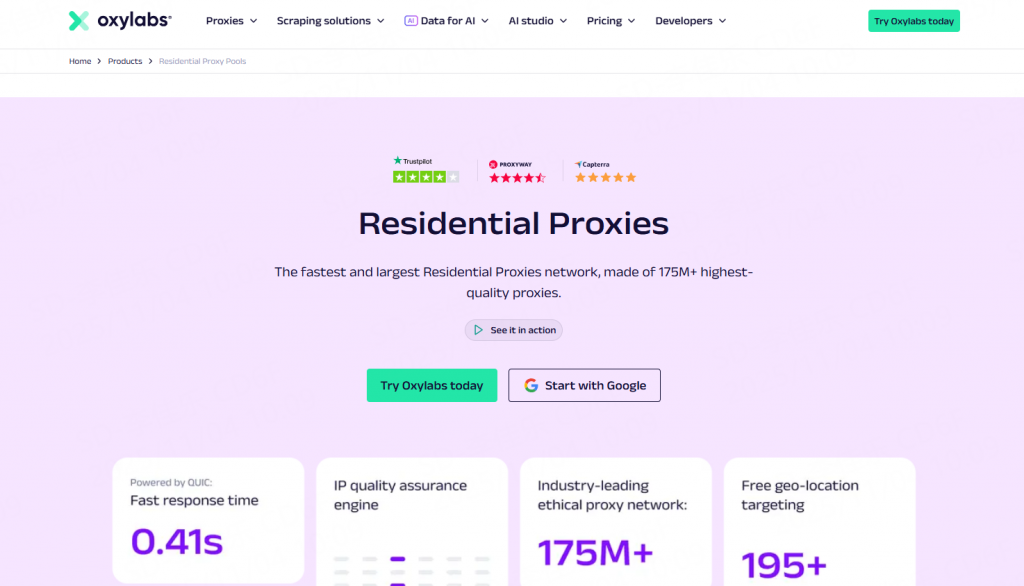
• Oxylabs provides residential proxies with a large IP pool coverage (175M+residential and global footprint).
• Avg success rate: 99.95%, Avg response time: 0.6s
• Filtering options: continent, country, city, state, ZIP‑code level; supports rotating & sticky sessions and HTTP(S)
• According to the official pricing page: Pay-as-you-go residential proxies cost approximately $4/GB, with a minimum top-up of 1GB.
• Starting prices range from around $3.87 to $3.49 per GB, depending on the tiered plan.
• User feedback: The service is reliable, but the price is relatively high.
• Large enterprise-scale users needing global residential proxy access, very high scale, multi-region scraping, brand protection, AI training data collection.
• Users for whom budget is less of a constraint and who prioritise scale and advanced features. Not ideal if your volume is very small or your budget is extremely limited.Suited for enterprise users, large-scale web scraping/data projects, global multi-site monitoring, brand protection, and AI datasets at scale.
Strengths:
high performance, mature infrastructure, strong reputation. It is indeed among the largest residential proxy providers in terms of pool size and global reach.
Weaknesses:
• Higher cost; smaller teams or lower-budget operations may find the pricing restrictive.
• Setup/complexity may be slightly higher relative to more “plug-and-play” providers for casual use.
Oxylabs is designed for large-scale enterprise and residential proxy use. It sets the benchmark for premium proxy infrastructure in the industry.
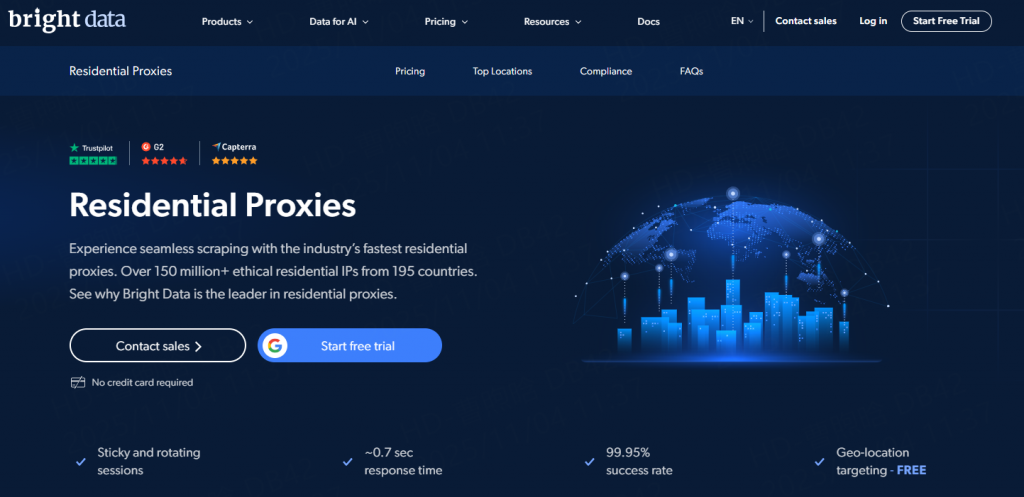
• Offers over 150 million residential proxy IPs (coverage in approximately 195+ countries).
• Supports both rotating and sticky sessions, HTTP(S) protocols.
• Boasts high success rates and responsiveness, plus broad API and tool integrations.
• Their pay‑as‑you‑go residential proxies start at around US $4.00 per GB.
• This is positioned at the premium end of the market; cost may be high for smaller‑scale users.
• Users who require high success rates, fine‐grained geo‑filtering, API & tool integration, and broad protocol support.
• Less suitable if your budget is constrained or your usage volume is relatively small.
Why Choose / What to Watch
Strengths:
• Very large pool, wide global reach, fine location targeting, high reliability.
• Rich feature set,multiple protocols, session types
Watch out for:
• Higher cost — may not be cost‑effective for smaller teams or low‑volume use.
• Rich feature can mean steeper learning or setup curve — may require more technical/operational effort.
• misuse, or non‑compliance, may result in blocking or other risks.
Bright Data is a top‑tier residential proxy provider aiming at large‑scale, globally distributed use cases. If your project demands cross‑border scale, multi‑region support, this is a very strong choice. But if you are working with a limited budget or smaller usage volume, you’ll need to evaluate whether the investment is justified.
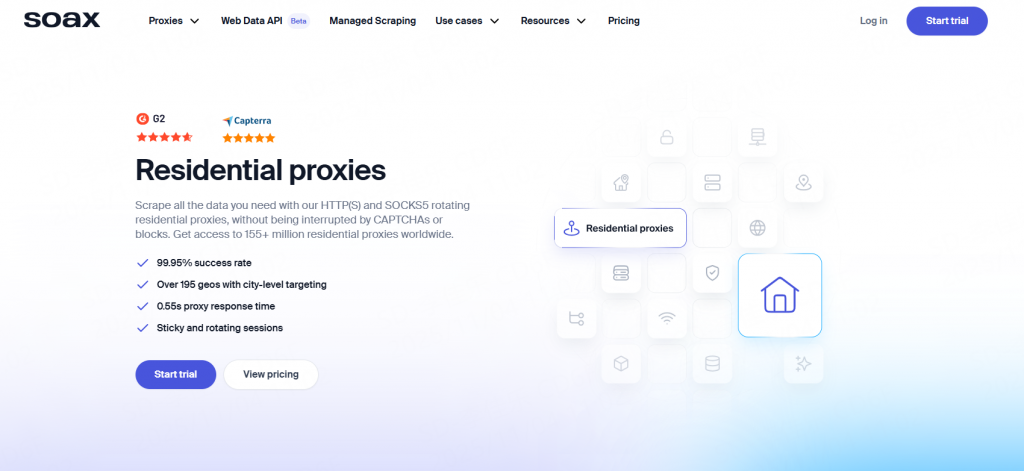
• SOAX offers a dedicated residential proxy product line. It boasts a massive IP address pool (over 155 million)
• Supports granular geo-targeting (country/city/ISP), and offers both session persistence and rotation modes for residential proxying. It supports HTTP.
• Uptime/Success Rate: 99.9%.
• roughly US $3.60/GB for 25 GB according to publicly quoted pricing.
• higher flows provide better $/GB but remain above some low-cost peers.
• Mid-sized organizations or teams needing flexible proxy types, not just entry-level.
• Suitable for medium to large-sized projects requiring residential agency services and flexible targeting capabilities.
• Not suitable for very limited budgets or very small-scale residential needs.
Strengths
• strong feature-set, good coverage, multi-type support.
• Mature product, high-quality residential agency services, transparent pricing.
Weaknesses
higher cost than budget providers—so for pure cost-driven small tasks it might not be optimal.Some providers may offer lower per GB prices for pure residential agency services.
SOAX is a mid-tier residential proxy provider, offering robust residential proxy features at a reasonable price. While not the absolute cheapest, it remains a reliable mid-range choice within the proxy ecosystem.
NetNut offers residential rotating and static residential proxies, claims over 85 M+ residential IPs globally and supports city/state level targeting.
• Entry plans show quotes like $3.53/GB and higher for smaller volumes.
• Dedicated/static residential options tend to cost more.
Mid to large-scale residential proxy users who want better performance, targeting, and global reach but wish to avoid the highest pricing tier.
Strengths
Strong residential proxy coverage, good feature‑set, decent value in mid-tier.
Weaknesses
Not quite at the highest end of “enterprise features,”.Entry cost is higher than pure budget providers; it may still be costly for very low‑budget users.
NetNut fits the “growth stage” user—above entry level, below full enterprise spend. Useful for your comparisons. Positioned for growth‑oriented residential proxy usage with moderate budgets.
• Offers residential proxy plans (rotating residential), supports global coverage (195 countries), and claims an IP pool of over 34 M+.
• Supports city-/state-level targeting and IP whitelisting.
• Easy dashboard, quick start, user-friendly interface.
The price of residential proxies ranges from approximately $3.50 to $2.45 per GB, with pay-as-you-go support. Prices vary by tier, emphasizing flexible and cost-effective pricing.
• Individuals, small teams, budget‑sensitive residential proxy users.
• Suitable for trial, research, and small to moderate residential proxy usage
Strengths
• Very cost-effective, approachable, easy to adopt
• Entry cost is comparatively low for residential proxies.
• Good for starting out or smaller scale use.
Weaknesses
• The IP pool size and enterprise-level features are slightly smaller than those of top-tier carriers; if the size is too large, it may pose potential risks to business development.
• Less suited for extremely large volumes or high enterprise demands.
IPRoyal is a budget-friendly residential proxy provider, suited for smaller-scale use or cost-sensitive residential proxy tasks—good when performance demands are moderate and cost is a major constraint.
• Provides static residential, rotating residential proxies; coverage across 195 countries claimed.
• Free‐tier/trial options make it accessible for entry users.
• Residential rotating proxies from $3.5/GB (annual payment).
• Individuals, small‐scale research, limited budget, pilot projects.
• Not ideal for heavy enterprise workloads where block-avoidance and scale are critical.
Strengths
• One of the lowest-cost entry points into residential proxies.good for experimentation
Weaknesses
• Performance, IP quality, and global coverage may lag behind higher‐end peers; fewer enterprise tools/APIs.
Webshare is a valid “entry‐level” benchmark in your market analysis—cost low, feature set basic.
• Offers over 125M+ IPs with coverage in approximately 195+ locations.
• Supports rotating and sticky sessions, wide protocol support, and browser extensions.
• On a pay‑as‑you‑go basis, residential proxies begin at about US $3.50 per GB.
• For large‑volume commitments, the per‑GB price may fall further.
• This pricing is seen as relatively cost‑effective for mid‑sized teams or smaller operations.
• Small to medium teams, individual researchers, and marketing/SEO teams needing broad but not extreme coverage.
Strengths:
• Strong value for money among non‑enterprise scale users; good performance and broad coverage for the price.
• Generally favourable user feedback on performance and reliability.
Weaknesses:
• At very high scale or with extremely stringent requirements (global maximum coverage, highest session density, extreme multisite scraping), it may not rival the largest enterprise‑grade providers(Thordata, Oxylabs, Brightdata).
• Some users report that customer support, billing/refund processes may be less polished compared to premium providers.
• As usage scales up, even though per‑GB price declines, total cost still rises alongside volume.
Decodo is a solid residential proxy offering positioned well for small to mid‑sized teams: good coverage, reliable performance, and more moderate cost. If you need broad functionality but don’t require the absolute top‑end scale, and budget is a consideration, this is a viable option.
The proxy market in 2025 has matured into layered tiers: from ultra-budget entry options, through mid-performance residential/ISP hybrids, to full enterprise global solutions. Choosing the right provider depends on your task volume, geographic scope, budget, and ecosystem integration.
① If you need to perform large-scale global data scraping or AI dataset collection, have a fully sufficient budget, and have stringent requirements for advanced features and scalability, consider top-tier providers such as Thordata, Oxylabs, and Bright Data.
② If you are cost-conscious but still require high-quality residential agency services at industry-leading prices and global coverage, Thordata strikes the best balance among these three factors, making it a highly attractive option.
Frequently asked questions
How to choose a suitable residential proxy provider based on your needs?
Large enterprises/large-scale global data scraping (sufficient budget): Prioritize Thordata, Oxylabs, and Bright Data. All three have super-large IP pools, high success rates, and comprehensive enterprise-grade features. Cost-sensitive but in need of high-quality services: Thordata is the optimal choice, balancing low prices, global coverage, and high performance..
Which residential proxy providers offer free trials?
Providers with free trials include: Thordata, Oxylabs, Bright Data, NetNut, and Decodo.
What core features do residential proxies have?
Support HTTP(S), country/city targeting, and rotating/sticky sessions.
What are residential proxies used for?
E-commerce data collection, social media management, SEO monitoring, AI data scraping, etc.
About the author
Stephen Jonathan is a content manager who specializes in creating engaging stories and impactful content. After starting his career in technology companies, he tried to combine creativity with data-driven insights. He always believed that every brand has its own unique story, and his mission is to help them be heard by the world.
The thordata Blog offers all its content in its original form and solely for informational intent. We do not offer any guarantees regarding the information found on the thordata Blog or any external sites that it may direct you to. It is essential that you seek legal counsel and thoroughly examine the specific terms of service of any website before engaging in any scraping endeavors, or obtain a scraping permit if required.
 Looking for
Top-Tier Residential Proxies?您在寻找顶级高质量的住宅代理吗?
Looking for
Top-Tier Residential Proxies?您在寻找顶级高质量的住宅代理吗?
How to Scraping Dynamic Websites with Python?
In this article, learn how to ...
Anna Stankevičiūtė
2026-03-03
Scraping Yahoo Finance using Python
Xyla Huxley Last updated on 2026-03-02 10 min read […]
Unknown
2026-03-03

TCP Deep Dive with Wireshark
Xyla Huxley Last updated on 2026-03-03 6 min read TCP i […]
Unknown
2026-03-03
Web Scraping with Python using Requests
Xyla Huxley Last updated on 2026-03-03 6 min read Web c […]
Unknown
2026-03-03
Crawl4AI: Open-Source AI Web Crawler with MCP Automation
Xyla Huxley Last updated on 2026-03-03 10 min read AI a […]
Unknown
2026-03-03

Using Wget with Python: A Practical Guide for Reliable, Scalable Web Data Retrieval
Xyla Huxley Last updated on 2026-03-03 10 min read […]
Unknown
2026-03-03

How to Make HTTP Requests in Node.js With Fetch API (2026)
A practical 2026 guide to usin ...
Kael Odin
2026-03-03

How to Scrape Job Postings in 2026: Complete Guide
A 2026 end-to-end guide to scr ...
Kale Odin
2026-03-03

BeautifulSoup Tutorial 2026: Parse HTML Data With Python
A 2026 step-by-step BeautifulS ...
Kael Odin
2026-03-03
