


Web Scraper API
Fetch real-time data from 100+ websites,No development or maintenance required.
SCRAPING SOLUTIONS
Get accurate and in real-time results sourced from Google, Bing, and more.
With 120+ prebuilt and custom scrapers ready for any use case.
No blocks, no CAPTCHAs—unlock websites seamlessly at scale.
Execute scripts in stealth browsers with full rendering and automation
PROXY INFRASTRUCTURE
Over 100 million real residential IPs from genuine users across 190+ countries.
Reliable mobile data extraction, powered by real 4G/5G mobile IPs.
For time-sensitive tasks, utilize residential IPs with unlimited bandwidth.
Fast and cost-efficient IPs optimized for large-scale scraping.
SCRAPING SOLUTIONS
PROXY INFRASTRUCTURE
DATA FEEDS
Full details on all features, parameters, and integrations, with code samples in every major language.
LEARNING HUB
ALL LOCATIONS Proxy Locations
TOOLS
RESELLER
Get up to 50%
Contact sales:partner@thordata.com
Products $/GB
Fetch real-time data from 100+ websites,No development or maintenance required.
Get real-time results from search engines. Only pay for successful responses.
Execute scripts in stealth browsers with full rendering and automation.
Bid farewell to CAPTCHAs and anti-scraping, scrape public sites effortlessly.
Dataset Marketplace Pre-collected data from 100+ domains.
Over 100 million real residential IPs from genuine users across 190+ countries.
Reliable mobile data extraction, powered by real 4G/5G mobile IPs.
For time-sensitive tasks, utilize residential IPs with unlimited bandwidth.
Fast and cost-efficient IPs optimized for large-scale scraping.

Data for AI $/GB
Pricing $0/GB
Docs $/GB
Full details on all features, parameters, and integrations, with code samples in every major language.
Resource $/GB
EN $/GB
产品 $/GB
AI数据 $/GB
定价 $0/GB
产品文档 $/GB
资源 $/GB
简体中文 $/GB
<–!>
<–!>

Google Hotels, as a large information aggregation platform, gathers millions of accommodation options from around the world, and by scraping hotel prices, we can access the latest aggregated hotel data at any time. This data includes price fluctuations, availability of listings, and real user reviews, which provide deep market insights that are crucial for developing dynamic pricing strategies. With an efficient Google Scraper API, you can retrieve structured raw data in an environment with no risk of bans. This article will explore the best Scraper API solutions to help you efficiently perform hotel data scraping.
Disclaimer: This article is for educational reference purposes only and does not constitute any legal advice. Before choosing any scraper API provider, it is recommended that you carefully visit and review the terms of service on their official website. At the same time, be sure to strictly comply with Google’s terms of service to ensure that data collection activities are in line with their regulations and respect data privacy, thereby ensuring the long-term sustainability and legality of data collection.

Web scraping is essentially an automated process of converting unstructured web data into a structured format. You can think of it as a digital “information harvesting,” except that the executor is not a person, but a program or script running according to predefined rules, whose core purpose is to perform data analysis, market research, or integrate into other applications, transforming the vast yet dispersed information on the internet into a database that can be analyzed.
Web scrapers achieve this by sending HTTP requests to the target server and obtaining HTML responses, and then parsing and extracting the desired data points from those responses. When you visit a hotel booking page, the browser renders a complete interface that includes images, text, and prices. What the scraper program sees is the source code of the page, which needs to accurately locate specific information such as room prices, hotel names, and check-in dates among complex HTML tags, CSS selectors, and JavaScript code, and “harvest” this information to store it in a database or spreadsheet.
As modern web pages increasingly adopt JavaScript for dynamic rendering, simple requests are no longer sufficient to retrieve all information, which is why developers are increasingly inclined to use more powerful Web Scraper API to handle complex web interactions.
Hotel prices fluctuate daily and even hourly, To survive in this fierce competition, obtaining real-time and accurate hotel data has become an urgent need in the industry.
• Competitive Pricing Analysis: Hotels and OTAs monitor competitors’ pricing strategies by scraping hotel prices, ensuring that their own prices remain competitive.
• Hotel Price Monitoring: Providing real-time budget control for corporate travel departments, to prevent irrational bookings during peak pricing periods.
• Investment and Revenue Management: Real estate investors or hotel management groups evaluate asset performance and optimize revenue management models by long-term tracking of price trends in specific areas or brands.
• Hotel Price Comparison API: Developers build aggregation platforms by scraping data, providing end users with a one-stop price comparison experience.
• Market Trend Research: Consulting firms, academic institutions, or travel analysts study seasonal demand variations, the impact of major events, or the influence of macroeconomics on the tourism industry by collecting historical and real-time price data.
• Travel Planning: Individual users or travel enthusiasts utilize scraping technology to find historical low points, to plan the most cost-effective itineraries.
• Customized Recommendation Engines: By analyzing historical price trends, travel companies can develop AI-based personalized travel recommendations for their clients.
We must acknowledge that web scraping currently exists in a complex gray area legally. The relevant legal rules vary by country and region, with some jurisdictions taking an open stance toward access to public data, while others restrict automated access through strict Terms of Service (ToS). Particularly when scraping Google Hotels data, it is essential to comply with its API usage guidelines, as violating these terms could result in your IP being permanently banned, and even facing the risk of legal action.
Before starting any scraping tasks, make sure to check the target website’s robots.txt file. This file is usually located in the root directory of the domain (e.g., thordata.com/robots.txt), and it specifies which directories or pages are allowed or disallowed for scraping. However, we need to remind you that just because a page is not blocked by robots.txt, it does not mean you can scrape at high frequencies without limits, as overloaded requests may be perceived as an attack on the server.
If you are uncertain about whether certain scraping behaviors are compliant, you might consider formally requesting permission. Many large platforms offer official API interfaces, allowing developers to legally access their data under agreed-upon rate limits and usage terms. Utilizing the free Web Scraper API services offered by these established providers, can assist you in testing your data collection logic within a compliant framework. Before launching large-scale web scraping, it is crucial to consult legal experts to assess potential risks.
Currently, there are three main methods for scraping hotel prices: manual collection, building your own crawler, and using specialized Web Scraper API services, here is a detailed comparison of these three methods:
| Method | Overview | Pros | Cons | User-Friendliness |
| Manual Collection | Manually copy and paste data | Zero technical barrier, completely free | Extremely low efficiency, prone to errors | Very high |
| Custom Script | Build your own scraper using Python/Node.js | Extremely flexible, highly customizable | High maintenance costs, prone to anti-scraping blocks | Low (requires programming background) |
| Web Scraper API | Call ready-made cloud data collection interfaces | Fully automatic, high success rate, plug and play | Requires a subscription fee | Medium to high (only needs simple API calls) |
Each scraping method has its merits, but for enterprise users who prioritize efficiency, Web Scraper APIs are clearly more reliable. Custom scripts often struggle when facing complex CAPTCHAs and rate limits, while professional API services significantly reduce the technical barriers by integrating dynamic proxies and request header masking.
The core value of the Web Scraper API lies in its ability to abstract the complexity of data scraping, allowing developers to access web data just like calling a standard cloud service. In addition, the Web Scraper API has the following advantages:
• Automatic Proxy Rotation: The system automatically assigns millions of residential IPs, effectively avoiding the risk of IP bans.
• Automatic CAPTCHA Recognition: It has built-in advanced algorithms that can seamlessly solve various complex image and behavior CAPTCHAs.
• JavaScript Rendering Support: It perfectly handles dynamically loaded content, ensuring that what is scraped is the complete rendered webpage result.
• Structured Data Output: It directly converts HTML into a clean JSON format, saving the complicated data cleaning steps.
• Geolocation Simulation: It can simulate access requests from any city around the world to obtain real hotel prices in that location.
• High Concurrency Handling: It supports large-scale parallel requests, completing the collection of tens of thousands of hotel information in a short period.
There are a myriad of Web Scraper API providers in the market, and choosing the tool that best suits your business requires multifaceted consideration, the most expensive option is not necessarily the best; the key is balancing performance and cost. Therefore, before making a purchase decision, be sure to conduct a thorough evaluation based on the following dimensions.
1. Success Rate and Stability: This is a core indicator. Ask the provider about their historical success rate on your target sites (such as Booking, Google Hotels), and conduct a short-term trial test.
2. Response Speed: The delay in data returned by the API directly affects your business efficiency, Responses in the millisecond range are the ideal choice.
3. Quality and Type of Proxy Network: Understand whether the proxies they provide are residential IPs, data center IPs, or mobile IPs, for sensitive targets like the Google Hotels price tracker, residential proxies are usually harder to detect but also come at a higher cost.
4. Anti-Scraping Capabilities: Does the API automatically handle CAPTCHAs (such as reCAPTCHA)? Does it have intelligent request scheduling, request header rotation, and other mechanisms to simulate real user behavior?
5. Data Parsing and Structured Output: Does the API return raw HTML, or is it already parsed and structured as JSON or CSV data? For scraping hotel prices, are the price, currency, taxes, and room types clearly and accurately separated and extracted?
6. Legal Compliance and Support: Does the provider clearly state its compliance stance regarding data collection? Do they offer relevant legal consulting support? Are their terms of service clear?
7. Technical Support and Documentation: Can you receive timely and professional technical support when issues arise? Is the API documentation clear, complete, and does it provide practical code examples?
8. Flexibility and Transparency of Pricing Model: Is the pricing based on the number of requests, bandwidth, or the number of successful scrapes? Are there any hidden fees? Can the plans be adjusted flexibly based on business growth?
The current web scraper API market is highly competitive, with each claiming to be the best option, Here are five top providers selected based on industry reputation and technical strength.
Thordata is a provider focused on offering high-quality, high-anonymity web data scraping solutions, with core advantages including a network of over 60 million real residential proxies and highly customizable data collection services. They not only provide a standard Scraper API, but also offer customized crawler development and data delivery solutions for complex scenarios like hotel price scraping. Their services are particularly suitable for mid to large enterprises that have high demands for data quality, scraping success rates, and evading anti-scraping measures.
Our team used their Web Scraper API to initiate a large number of scraping requests to Google Hotels and conducted stress tests.
• Process: Our team ran continuous tests for 48 hours, initiating 50 requests per second, simulating search behaviors from 12 different cities around the world.
• Results: The tests showed that its success rate remained stable at over 99.2%, and it was able to perfectly bypass Google’s strictest sliding CAPTCHA challenges.
• Experience: We found their backend dashboard to be very intuitive, allowing real-time monitoring of traffic consumption and request status, which significantly reduced operational pressure.

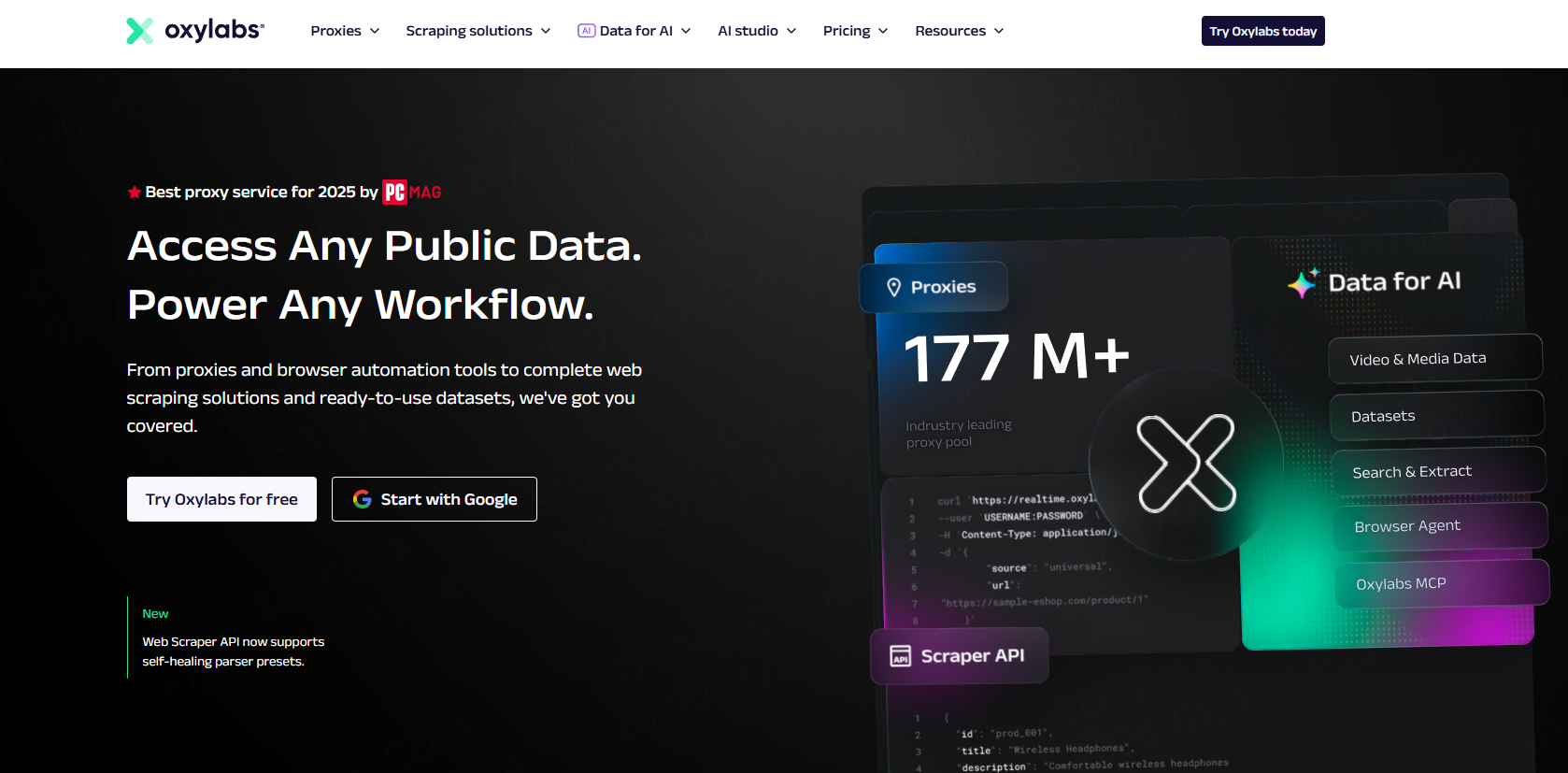
Oxylabs is one of the giants in the industry, known for its large-scale and diverse proxy network (residential, datacenter, mobile) and robust scraping infrastructure. Their Web Scraper API product is highly mature, offering very precise control options for geolocation and JavaScript rendering, making it suitable for large enterprises that need to scrape hotel price data from around the world.
Brightdata (formerly Luminati) has the world’s largest residential proxy network. Its product line is very comprehensive, ranging from basic proxies to complete data collection solutions. Their Web Unlocker and Data Collector products efficiently handle complex targets, including Google Hotels, with powerful dashboards and APIs that make management and integration relatively easy.
Decodo may not be as well-known as the previous companies, but it has built a good reputation among specific user groups with its flexible solutions and competitive pricing. They offer customized scraping services and APIs, which are responsive and suitable for mid-sized projects with specific scraping logic needs but relatively limited budgets.
Zyte (formerly Scrapinghub) is the commercial company behind the Scrapy framework, and enjoys a high technical reputation within the developer community. Their Smart Proxy Manager and Automatic Extraction API combine intelligent proxy management with AI-driven data parsing, excelling in automating the handling of complex website structures, and are highly favored by technical teams.
| Provider | Proxy Pool | Data Delivery | Concurrency | Billing Model | Additional Fees | Starting Price |
| Thordata | 60M+ | JSON, CSV, XLSX | 10K | Pay per successful result | ❌ | 7-day free trial with 5,000 credits |
| Oxylabs | 177M+ | JSON | Not disclosed | Pay per successful result | ✔️ (VAT) | $49/month |
| Brightdata | 150M+ | JSON, CSV | 5K | Pay per successful result | ❌ | $499/month |
| Decodo | 125M+ | HTML, JSON, CSV | 200 | Pay per successful request | ✔️ (VAT) | $20/month |
| Zyte | Not disclosed | Not disclosed | Not disclosed | Pay based on actual usage | ❌ | $100/month |
The technical process for scraping hotel prices typically consists of three steps: selecting tools, constructing requests, and parsing responses. Here, we will demonstrate how to use an API to retrieve data. Please note that the following code is for conceptual demonstration only, and actual calls should be replaced with real API endpoints, keys, and parameters.
• Tools: Thordata’s Web Scraper API, requests library, Python
• Objective: Retrieve a list of hotels and prices in the “Paris” area for check-in on “2026-02-01” and check-out on “2026-02-03” for 2 adults.
Python

import requests
import json

# Configure your API credentials and target parameters
API_KEY = "YOUR_API_KEY_HERE"
API_ENDPOINT = "https://api.thordat.com/v1/scrape"  # Replace with the actual endpoint
TARGET_URL = "https://www.google.com/travel/hotels/Paris?checkIn=2026-2-01&checkOut=2026-2-03&adults=2"

# Construct the API request payload
payload = {
    "api_key": API_KEY,
    "url": TARGET_URL,
    "render_js": True,  # Enable JavaScript rendering
    "country": "us",    # Specify proxy geolocation (optional)
    "output": "json"    # Request structured JSON output
}

# Send POST request to the Scraper API
response = requests.post(API_ENDPOINT, json=payload)

# Check if the request was successful
if response.status_code == 200:
    data = response.json()

    # Assume the API returns the list of hotels under the 'hotels' field
    hotels = data.get('hotels', [])

    for hotel in hotels:
        name = hotel.get('name')
        price = hotel.get('total_price')
        currency = hotel.get('currency')

        # Process data, such as saving to a database or printing
        print(f"Hotel: {name}, Total Price: {price} {currency}")

else:
    print(f"Request failed, status code: {response.status_code}")
    print(response.text)
Developers do not need to worry about how to retrieve the HTML at a lower level, how to bypass CAPTCHAs, or how to use proxies; they only need to focus on the target URL and the required data fields. The provider's system will handle all the heavy lifting, and deliver clean data to you.
Scraping price information from Google Hotels is particularly challenging, because Google has one of the most advanced anti-scraping defense systems in the world. Any attempts to directly and aggressively scrape its data will quickly trigger a series of defense mechanisms. Understanding these challenges is a prerequisite for developing effective counter-strategies.
1. Dynamic Content and JavaScript Rendering: Google Hotels pages heavily rely on JavaScript to load and display prices, hotel lists, and other information. Simple HTTP requests can only retrieve an empty or incomplete HTML framework, and it is recommended to use tools or APIs that support headless browser rendering, to fully simulate the browsing behavior of real users.
2. IP Blocking and Rate Limiting: High-frequency requests from a single IP address will be immediately recognized and blocked by Google. By using a highly anonymous residential proxy pool and implementing smart rotation, requests can be spread across a large number of different IP addresses, simulating normal access from users across the globe.
3. CAPTCHA Interceptions: When suspicious behavior is detected, Google will pop up a CAPTCHA or silently intercept the request. You can attempt to address this by integrating automated decoding services or using a Google Scraper API with behavioral simulation capabilities.
4. Frequent Changes in Page Structure: Google periodically updates its front-end code and page layout, causing previously written data parsing rules (XPath/CSS selectors) to become ineffective. You can conduct regular checks and be prepared to quickly update parsing logic, Using APIs with certain AI parsing capabilities can enhance adaptability to such changes.
5. Data Irregularities and Complexity: Price displays may contain various formats such as promotional prices, crossed-out original prices, tax descriptions, and package bundles, Extracting pure numerical prices and associating them with the correct room types and dates requires meticulous parsing logic. It is recommended to choose experienced parser developers, or select providers with substantial expertise in APIs, who have productized these parsing logics.
Although scraping hotel prices involves various technical paths, when considering development costs, maintenance difficulty, legal risks, and scalability, using a professional Web Scraper API is undoubtedly the optimal solution in most commercial application scenarios, which can overcome technical barriers and achieve automated, scalable data collection. When selecting a provider, be sure to return to your core needs: data quality, stability, compliance, and total ownership costs, whether you are looking to optimize pricing models, or to build the next generation of travel applications, stable and high-quality hotel data will be the cornerstone of your success.
If you want to learn more about other information regarding web scraping, please visit our articles – "Best Amazon ASIN Scraper APIs" and "Best Web Scraping Proxy Services".
We hope the information provided is helpful. However, if you have any further questions, feel free to contact us at support@thordata.com or via online chat.

<--!>
Frequently asked questions
Is Price Scraping Legal?
Scraping publicly visible price data is generally considered legal, provided that you comply with the target website’s robots.txt file and do not use the scraped data for infringing or malicious purposes. It is always recommended to review the latest terms of service of the relevant platforms.
How to Use the Google Hotel API?
Google does not offer an official public API called “Google Hotel API” for scraping price data from its travel pages. Instead, Google provides partners with solutions such as the Google Hotel Ads API, which are designed for managing advertising campaigns rather than for general data collection. As a result, the commonly mentioned “Google Scraper API” usually refers to third-party services that specialize in extracting data from Google Hotels and other Google services.
How Does Price Scraping Work?
Price scraping works by simulating a browser visit to specific hotel listing pages, downloading the page’s source code, and then using selectors (such as CSS selectors or XPath) to extract key fields like prices, hotel names, and ratings. The extracted data is then saved in a structured format for further use.
<--!>
About the author
Anna is a content specialist who thrives on bringing ideas to life through engaging and impactful storytelling. Passionate about digital trends, she specializes in transforming complex concepts into content that resonates with diverse audiences. Beyond her work, Anna loves exploring new creative passions and keeping pace with the evolving digital landscape.
The thordata Blog offers all its content in its original form and solely for informational intent. We do not offer any guarantees regarding the information found on the thordata Blog or any external sites that it may direct you to. It is essential that you seek legal counsel and thoroughly examine the specific terms of service of any website before engaging in any scraping endeavors, or obtain a scraping permit if required.
 Looking for
Top-Tier Residential Proxies?您在寻找顶级高质量的住宅代理吗?
Looking for
Top-Tier Residential Proxies?您在寻找顶级高质量的住宅代理吗?
How to Scraping Dynamic Websites with Python?
In this article, learn how to ...
Anna Stankevičiūtė
2026-03-03
Scraping Yahoo Finance using Python
Xyla Huxley Last updated on 2026-03-02 10 min read […]
Unknown
2026-03-03
TCP Deep Dive with Wireshark
Xyla Huxley Last updated on 2026-03-03 6 min read TCP i […]
Unknown
2026-03-03
Web Scraping with Python using Requests
Xyla Huxley Last updated on 2026-03-03 6 min read Web c […]
Unknown
2026-03-03
Crawl4AI: Open-Source AI Web Crawler with MCP Automation
Xyla Huxley Last updated on 2026-03-03 10 min read AI a […]
Unknown
2026-03-03
Using Wget with Python: A Practical Guide for Reliable, Scalable Web Data Retrieval
Xyla Huxley Last updated on 2026-03-03 10 min read […]
Unknown
2026-03-03
How to Make HTTP Requests in Node.js With Fetch API (2026)
A practical 2026 guide to usin ...
Kael Odin
2026-03-03

How to Scrape Job Postings in 2026: Complete Guide
A 2026 end-to-end guide to scr ...
Kale Odin
2026-03-03

BeautifulSoup Tutorial 2026: Parse HTML Data With Python
A 2026 step-by-step BeautifulS ...
Kael Odin
2026-03-03
