


Web Scraper API
Fetch real-time data from 100+ websites,No development or maintenance required.
SCRAPING SOLUTIONS
Get accurate and in real-time results sourced from Google, Bing, and more.
With 120+ prebuilt and custom scrapers ready for any use case.
No blocks, no CAPTCHAs—unlock websites seamlessly at scale.
Execute scripts in stealth browsers with full rendering and automation
PROXY INFRASTRUCTURE
Over 100 million real residential IPs from genuine users across 190+ countries.
Reliable mobile data extraction, powered by real 4G/5G mobile IPs.
For time-sensitive tasks, utilize residential IPs with unlimited bandwidth.
Fast and cost-efficient IPs optimized for large-scale scraping.
SCRAPING SOLUTIONS
PROXY INFRASTRUCTURE
DATA FEEDS
Full details on all features, parameters, and integrations, with code samples in every major language.
LEARNING HUB
ALL LOCATIONS Proxy Locations
TOOLS
RESELLER
Get up to 50%
Contact sales:partner@thordata.com
Products $/GB
Fetch real-time data from 100+ websites,No development or maintenance required.
Get real-time results from search engines. Only pay for successful responses.
Execute scripts in stealth browsers with full rendering and automation.
Bid farewell to CAPTCHAs and anti-scraping, scrape public sites effortlessly.
Dataset Marketplace Pre-collected data from 100+ domains.
Over 100 million real residential IPs from genuine users across 190+ countries.
Reliable mobile data extraction, powered by real 4G/5G mobile IPs.
For time-sensitive tasks, utilize residential IPs with unlimited bandwidth.
Fast and cost-efficient IPs optimized for large-scale scraping.

Data for AI $/GB
Pricing $0/GB
Docs $/GB
Full details on all features, parameters, and integrations, with code samples in every major language.
Resource $/GB
EN $/GB
产品 $/GB
AI数据 $/GB
定价 $0/GB
产品文档 $/GB
资源 $/GB
简体中文 $/GB
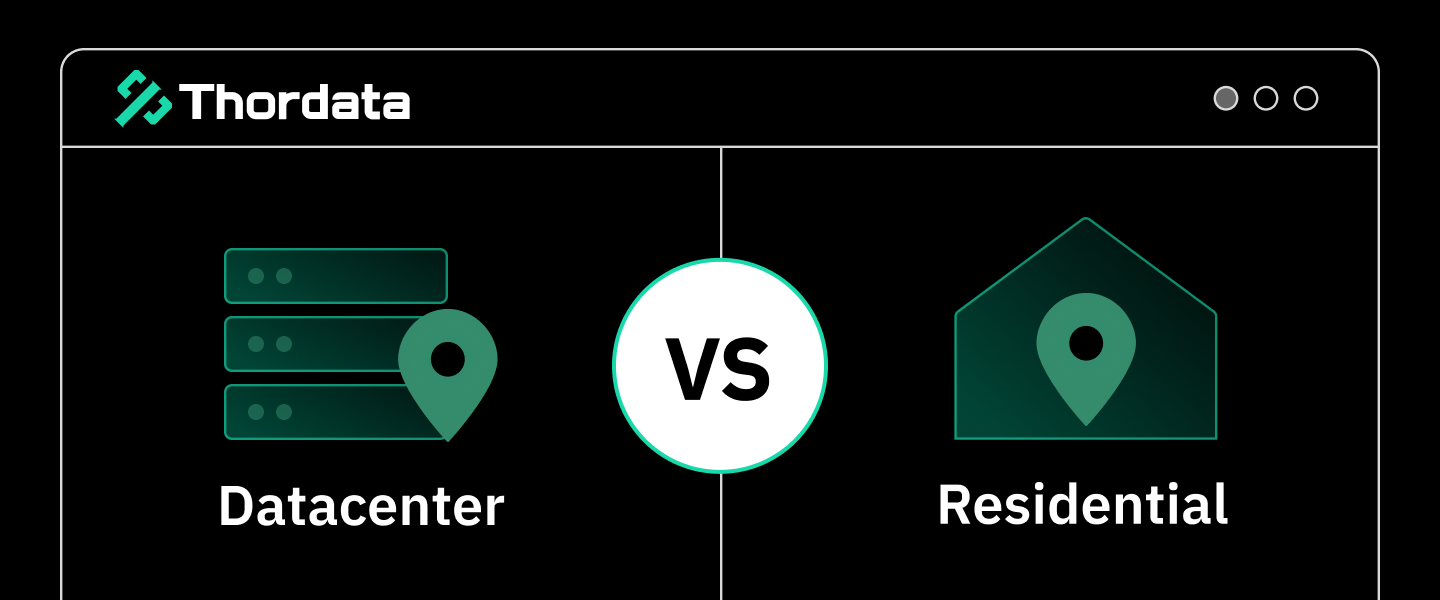

Datacenter proxies and residential proxies are both important tools for achieving anonymous access and data collection. Their core role is the same—hiding the user’s real IP address—but they also have significant differences in terms of speed, cost, stability, and use cases. This article will provide an in-depth analysis of these two types of proxies to help you make the most suitable choice based on your business needs.

Datacenter proxies are proxy servers based on cloud servers rather than real user devices. They relay network requests using IP addresses provided by data centers, which come from third-party independent companies and do not belong to any Internet Service Provider, offering users strong privacy and anonymous IP addresses.

However, since the IPs of datacenter proxies are sourced from cloud service providers or hosting services, large numbers of IP addresses can be generated in bulk. These addresses are often used simultaneously by many users, and if a particular IP gets flagged or banned by a website, users in the same IP range may face penalties. In Thordata’s datacenter proxies, this situation does not occur; you can choose between dedicated or shared datacenters based on your business needs. Thordata’s dedicated datacenter proxies are exclusively for users, ensuring that you are not affected by the malicious actions of others.
Datacenter proxies can be primarily divided into two core types based on resource allocation and usage permissions, each serving specific journey needs like different types of vehicles. Understanding these differences is the first step to making the right choice. Below, we will explore the unique aspects of private proxies, shared proxies.
These proxies are exclusively assigned to a single user, offering the highest levels of performance, security, and control. Since no other users compete for bandwidth or IP resources, you will enjoy stable and predictable connection speeds. This type of proxy is typically used by businesses or high-demand users, as it ensures resource exclusivity and avoids interference from other users. For example, they are ideal for managing sensitive business accounts or engaging in high-frequency trading.
These allow multiple users to share IP addresses and server resources from a proxy pool. The main appeal of this model lies in its cost-effectiveness, with prices significantly lower than private proxies. It is well-suited for budget-conscious tasks that do not demand high performance or absolute security, such as basic data scraping, price monitoring, or bypassing simple geographic restrictions.
Many companies and individuals rely on datacenter proxies for higher speeds, lower costs, and—most importantly—avoiding IP address blocks during large-scale data collection. Here are the industries that most frequently use datacenter proxies:
● E-Sports
● Data Scraping
The following is our actual operation of using datacenter proxies to scrape the local retail prices of Nike shoes from eBay.de.
Test Description: In our tests, the goal is to collect the current prices of popular Nike shoe models (such as Air Force 1, Dunk, Air Jordan series, etc.) from German sellers marked ‘Versand aus Deutschland’ (shipping to Germany only), as these prices reflect the true local retail/resale prices rather than inflated international prices. We need to collect hundreds of data points daily for several weeks to track how prices change with new releases, restocks, and seasonal promotions.
Script: Our team built the scraper using Python and httpx + parsel
The core part of the proxy integration is shown below:
import httpx
from parsel import Selector
import random

# Our datacenter proxy pool (100 IPs from a provider in Frankfurt and Amsterdam)
proxy_list = [
    "http://user:pass@123.45.67.89:8000",
    "http://user:pass@123.45.67.90:8000",
    # ... 98 more
]

headers = {
    "User-Agent": "Mozilla/5.0 (Windows NT 10.0; Win64; x64) AppleWebKit/537.36",
    "Accept-Language": "de-DE,de;q=0.9,en-US;q=0.8",
    "Accept-Encoding": "gzip, deflate, br",
}

def get_proxy():
    return random.choice(proxy_list)

for page in range(1, 51):  # eBay usually allows ~50 pages before heavy CAPTCHA
    proxy = get_proxy()
    url = f"https://www.ebay.de/sch/i.html?_nkw=nike+{model}&_sacat=0&LH_TitleDesc=0&LH_BIN=1&LH_ItemCondition=1000&LH_PrefLoc=1&_pgn={page}"

    response = httpx.get(
        url,
        headers=headers,
        proxies={"http://": proxy, "https://": proxy},
        timeout=15.0
    )
    # parsing logic here...
Datacenter proxies played three key roles in our tests:
1. Speed—All 100 IP addresses are hosted in German or nearby European data centers (Frankfurt, Amsterdam), which gives us a latency of only 3-8 milliseconds when accessing eBay.de. With 50 concurrent workers, the total throughput is about 180-250 requests per second.
2. Anti-blocking mechanism—eBay.de strictly limits the access rates of residential or mobile IPs and bans them when crawler patterns are detected. While datacenter IPs can theoretically be detected, if they are rotated and the request intervals are reasonable (we added random delays of 400-1200 milliseconds), the tolerance is much higher. Over a period of 18 days, we made approximately 1.37 million requests without receiving any permanent bans—only occasional captchas, which we successfully resolved using 2Captcha (with a success rate of 98.7%).
3. Geolocation consistency—Since all proxy servers use IP addresses from European datacenters, eBay consistently shows us localized prices in euros and shipping options within Germany. If we use residential proxies from Asian or American data centers, much product information would be hidden, or the price conversion would be very unfavorable.
The final results of our continuous operation over 18 days:
● Successfully collected 412,683 valid Nike shoe product listings from German sellers.
● Average price tracking accuracy for popular models: ±0.7% compared to manual validation.
● Total cost for proxy servers: approximately $340.
● eBay accounts with zero bans and zero IP blacklisting.
For high-capacity, speed-sensitive scraping tasks in specific geographical locations, if residential proxies are too slow or costly, datacenter proxies remain the most efficient and economical solution—our tests on eBay in Germany have confirmed this once again.

Residential proxies use IP addresses assigned by Internet Service Providers (ISPs) to real home networks. These IPs are associated with real physical devices and route user traffic, thus simulating genuine human behavior, making user access requests hard for websites to detect.
Today, the procurement of residential proxies must comply with ethical standards, which has become a ‘compliance red line.’ That is, truly compliant residential proxies should be sourced based on legitimate authorization, real user consent, and transparent collaboration mechanisms, ensuring that each IP address is traceable and compliant with regulations.
In contrast, using unethical or illegal means to acquire residential IPs can lead to dangers such as business interruptions, legal disputes, and data breaches. As a proxy provider driven by ethical compliance standards, Thordata consistently insists on acquiring proxies in an ethical manner and protects user data privacy in accordance with regulations like GDPR, helping users avoid risks from the source.
We have a blog post dedicated to exploring the importance of ethically sourcing residential proxies—please check out the article for a more comprehensive understanding.
Residential proxies are primarily categorized based on how IP addresses are allocated and used, with the core distinction being whether the IP addresses are dynamically changing or fixed. Understanding these two types can help you make a choice based on your specific needs.
The key feature of rotating proxies is that the IP addresses automatically and frequently change according to preset rules. These proxies assign a new residential IP to users after each request or at specific intervals (e.g., every few minutes) from a large IP pool. This dynamic nature provides a higher level of anonymity, making it ideal for tasks that require simulating a large number of different users or conducting large-scale data collection, as it effectively avoids being banned by the target website due to excessive requests from a single IP address.
Static proxies, on the other hand, provide long-term fixed residential IP addresses. You can exclusively use the same IP for several days, weeks, or even months. This stability makes them suitable for tasks that require maintaining continuous sessions or establishing trustworthy IP records. For example, managing social media accounts, performing web operations that require long-term logins, or accessing banking websites that demand IP consistency can benefit from static proxies, ensuring that your login environment doesn’t trigger security alerts due to IP changes.
Residential proxies allow you to browse and operate like a real local user, which is the only effective way to bypass modern anti-bot systems on platforms like Instagram, TikTok, and Facebook. Businesses use residential proxies specifically for tasks where any signs of ‘proxy behavior’ could lead to account restrictions, shadow bans, or total loss of access.
Residential proxies are particularly useful in the following business areas:
● Social Media Operations
● Market Research
● Ad Verification
The following is a real use case run by our team: Our social media expert Jane uses residential proxies to manage multiple Instagram accounts, and simultaneously conducts Black Friday promotions targeting different countries/regions—without triggering Instagram’s anti-spam system.
Test Description: In our tests, we need to use 120 different Instagram accounts to post Black Friday promotional stories, short videos, and dynamic messages, with each account appearing to Instagram as a real local user from the target markets (the USA, UK, Germany, France, Canada, Australia). The content has been localized (using different currencies, language tags, and hashtags based on the region), and all accounts must remain active throughout November 2025 without facing any restrictions or throttling.
Script: By combining the Instagrapi library and Selenium, each account is linked to its dedicated residential proxy.
The core proxy settings are as follows:
from instagrapi import Client
import random

# Static residential proxies — one dedicated IP per account (country-matched)
PROXY_POOL = {
    "US": "http://user:pass@us-resi-provider-123.resi.example.com:10000",
    "UK": "http://user:pass@uk-resi-provider-456.resi.example.com:10001",
    "DE": "http://user:pass@de-resi-provider-789.resi.example.com:10002",
    # ... 30+ countries
}

def get_client(username, password, country):
    cl = Client()
    proxy = PROXY_POOL[country]
    cl.set_proxy(proxy)

    # Additional anti-detection settings
    cl.set_device({
        'android_version': 34,
        'android_release': '14',
        'manufacturer': random.choice(['Samsung', 'Google', 'OnePlus', 'Xiaomi']),
        'model': random.choice(['SM-G998B', 'Pixel 7', '2210132G']),
    })
    cl.login(username, password)
    return cl
Residential proxies were absolutely critical for three reasons:
1. Discreteness—Instagram immediately flags IP addresses from datacenters to prevent bulk operations. We used residential proxies (all from Thordata, with clean, real ISP IP addresses), achieving a 99.8% login success rate during the entire promotional campaign, and encountered almost no temporary bans, even while using 120 accounts daily for posting/uploading/storing operations.
2. Geolocation authenticity—The content posted by each account perfectly matched its proxy location(US IP addresses posting prices in dollars + US tags, German IP addresses posting prices in euros + German tags). Instagram’s algorithm recognized completely natural behavior, without lowering the reach of any account or applying any form of throttling.
3. Session stability—Using static residential IP addresses (which remain unchanged for a month) means cookies, device fingerprints, and login sessions are always completely consistent. There were no ‘suspicious login location’ warnings, nor were there any loops of phone verification.
The final results of our “Black Friday” promotional campaign in November 2025:
● 120 accounts are continuously active for 30 days.
● Released over 18,400 posts/stories/short videos as planned.
● Total reach: 47.3 million impressions.
● Average engagement rate was 42% higher than the same campaign the previous year(when we used a mixed model of datacenter + rotating residential proxies).
● Proxy costs: Approximately $2,800 for 120 static residential IP addresses for one month.
When it is necessary to operate multiple social media accounts at scale on the strictest anti-bot platforms, residential proxies (especially high-quality static proxies) are the only reliable solution.
The core difference between datacenter proxies and residential proxies stems from the origin of their IP addresses, which directly influences their performance, anonymity, cost, and applicable scenarios.
The following table clearly summarizes their comparisons across various aspects:
|
Comparison Dimension |
Datacenter Proxies |
Residential Proxies |
|
IP Address Source |
Cloud server farms |
Real residential networks |
|
Anonymity Level |
Low, easily identifiable |
Extremely high, hard to trace |
|
Success Rate |
Low for sensitive targets |
High for various targets |
|
Connection Speed |
High and stable |
Affected by residential network conditions |
|
Cost Structure |
Economical |
Relatively expensive |
|
Compliance Risk |
Requires cautious use |
Relatively low risk |
|
Typical Applications |
Big data collection, SEO monitoring |
Social media management, ad verification |
👉 In terms of IP address source, datacenter proxies provide IPs in bulk from hosting service providers, while residential proxies obtain their IPs from residential broadband networks. This fundamental difference gives residential proxies a natural advantage when accessing websites that require verification of real user identities.
👉 Regarding performance, datacenter proxies rely on the infrastructure of professional data centers, offering enterprise-level network bandwidth and stability. In contrast, the performance of residential proxies is constrained by the quality of residential broadband, leading to limitations in speed and stability.
👉 From a cost perspective, datacenter proxies have a clear price advantage due to the scalability of their IP resources. Residential proxies, on the other hand, require the establishment and maintenance of a real residential IP network, resulting in higher costs that are directly reflected in service pricing.
👉 In terms of compliance, datacenter proxies are more easily identified by websites, leading to access restrictions, while residential proxies, due to their authenticity, present relatively lower compliance risks during use. This is an important reason why residential proxies are often recommended in fields like finance and social media.
Choosing between datacenter proxies and residential proxies comes down to what you need most—speed, cost savings, or the ability to blend in and avoid blocks. Let’s break down when each type makes sense for you.
● Batch processing tasks require high-speed performance.
● You want to reduce costs.
● You plan to scrape public data or perform SEO monitoring.
● You do not need to bypass strict anti-bot systems.
● You have the technical skills to manage proxy rotation and sessions.
● You need to bypass robust anti-bot systems.
● For sensitive tasks, you want the highest success rate.
● You need to appear as a real user from a specific location.
● You handle content that is geo-restricted or region-specific.
● You value anonymity and wish to avoid detection.
● Small businesses often start with datacenter proxies for basic scraping and monitoring because of the lower price. If you hit blocks or need to access restricted content, try residential proxies for those specific tasks.
● Enterprises usually need both types. Use datacenter proxies for large-scale, non-sensitive data collection. Switch to residential proxies for social media, ad verification, or anything that requires stealth and authenticity.
● Developers should match the proxy type to the project. For fast prototyping or bulk data, datacenter proxies work well. For production tools that need to avoid detection, residential proxies are safer.
Through this comprehensive comparison, we can clearly see that datacenter proxies and residential proxies are not simply a matter of superiority but are specialized tools aimed at different application scenarios. When choosing a type of proxy, we recommend using a decision framework based on business needs: first, clarify whether your core requirement is speed or anonymity; second, assess the strictness of the target website’s anti-scraping measures; and finally, weigh the project budget against long-term maintenance costs.
Thordata, as an industry-leading proxy service provider, controls a network of over 100 million residential IPs across more than 190 countries/regions. Their pricing for proxy services is as follows:
● Residential Proxies: Support sticky sessions and rotating sessions, starting at $1.80/GB
● Datacenter Proxies: High-performance IPs, starting at $0.75/IP
● Static ISP Proxies: Permanent sessions, starting at $0.75/IP
● Mobile Proxies: 600K+ real-time mobile IPs, starting at $2.20/GB
👍 Note: Thordata offers a free trial!
If you would like to read more quality articles, please check out “ISP Proxies vs Residential Proxies,” “ISP Proxy Guide,” “What Are Static Residential Proxies,” and “Best Mobile Proxy Providers of 2025.”
Frequently asked questions
How to use a datacenter proxy?
Using datacenter proxies typically involves the following steps: First, purchase proxy services from a provider; then, configure the proxy IP and port in your application or browser; finally, test the connection to ensure it works properly. Most services provide an API or control panel to simplify management.
Are residential proxies always slower than datacenter proxies?
Not necessarily. While residential proxies are often slower due to residential network constraints, high-end services have reduced latency through optimization. Actual speed depends on the provider’s infrastructure and your network environment.
Can you use datacenter proxies for social media automation?
Yes, but it is not recommended. Social media platforms can easily detect datacenter IPs, which may lead to account bans. Residential proxies are better suited for such tasks as they provide higher anonymity.
What is the difference between datacenter proxies and ISP proxies?
Datacenter proxies use IPs from third-party data centers, while ISP proxies have IPs directly allocated by internet service providers, making them closer to residential proxies but generally more stable. ISP proxies combine the speed of datacenters with the anonymity of residential proxies, but they tend to be more expensive.
<–!>
About the author
Anna is a content specialist who thrives on bringing ideas to life through engaging and impactful storytelling. Passionate about digital trends, she specializes in transforming complex concepts into content that resonates with diverse audiences. Beyond her work, Anna loves exploring new creative passions and keeping pace with the evolving digital landscape.
The thordata Blog offers all its content in its original form and solely for informational intent. We do not offer any guarantees regarding the information found on the thordata Blog or any external sites that it may direct you to. It is essential that you seek legal counsel and thoroughly examine the specific terms of service of any website before engaging in any scraping endeavors, or obtain a scraping permit if required.
 Looking for
Top-Tier Residential Proxies?您在寻找顶级高质量的住宅代理吗?
Looking for
Top-Tier Residential Proxies?您在寻找顶级高质量的住宅代理吗?
How to Scraping Dynamic Websites with Python?
In this article, learn how to ...
Anna Stankevičiūtė
2026-03-03
Scraping Yahoo Finance using Python
Xyla Huxley Last updated on 2026-03-02 10 min read […]
Unknown
2026-03-03
TCP Deep Dive with Wireshark
Xyla Huxley Last updated on 2026-03-03 6 min read TCP i […]
Unknown
2026-03-03
Web Scraping with Python using Requests
Xyla Huxley Last updated on 2026-03-03 6 min read Web c […]
Unknown
2026-03-03
Crawl4AI: Open-Source AI Web Crawler with MCP Automation
Xyla Huxley Last updated on 2026-03-03 10 min read AI a […]
Unknown
2026-03-03
Using Wget with Python: A Practical Guide for Reliable, Scalable Web Data Retrieval
Xyla Huxley Last updated on 2026-03-03 10 min read […]
Unknown
2026-03-03
How to Make HTTP Requests in Node.js With Fetch API (2026)
A practical 2026 guide to usin ...
Kael Odin
2026-03-03

How to Scrape Job Postings in 2026: Complete Guide
A 2026 end-to-end guide to scr ...
Kale Odin
2026-03-03

BeautifulSoup Tutorial 2026: Parse HTML Data With Python
A 2026 step-by-step BeautifulS ...
Kael Odin
2026-03-03
