


Web Scraper API
Fetch real-time data from 100+ websites,No development or maintenance required.
SCRAPING SOLUTIONS
Get accurate and in real-time results sourced from Google, Bing, and more.
With 120+ prebuilt and custom scrapers ready for any use case.
No blocks, no CAPTCHAs—unlock websites seamlessly at scale.
Execute scripts in stealth browsers with full rendering and automation
PROXY INFRASTRUCTURE
Over 100 million real residential IPs from genuine users across 190+ countries.
Reliable mobile data extraction, powered by real 4G/5G mobile IPs.
For time-sensitive tasks, utilize residential IPs with unlimited bandwidth.
Fast and cost-efficient IPs optimized for large-scale scraping.
SCRAPING SOLUTIONS
PROXY INFRASTRUCTURE
DATA FEEDS
Full details on all features, parameters, and integrations, with code samples in every major language.
LEARNING HUB
ALL LOCATIONS Proxy Locations
TOOLS
RESELLER
Get up to 50%
Contact sales:partner@thordata.com
Products $/GB
Fetch real-time data from 100+ websites,No development or maintenance required.
Get real-time results from search engines. Only pay for successful responses.
Execute scripts in stealth browsers with full rendering and automation.
Bid farewell to CAPTCHAs and anti-scraping, scrape public sites effortlessly.
Dataset Marketplace Pre-collected data from 100+ domains.
Over 100 million real residential IPs from genuine users across 190+ countries.
Reliable mobile data extraction, powered by real 4G/5G mobile IPs.
For time-sensitive tasks, utilize residential IPs with unlimited bandwidth.
Fast and cost-efficient IPs optimized for large-scale scraping.

Data for AI $/GB
Pricing $0/GB
Docs $/GB
Full details on all features, parameters, and integrations, with code samples in every major language.
Resource $/GB
EN $/GB
产品 $/GB
AI数据 $/GB
定价 $0/GB
产品文档 $/GB
资源 $/GB
简体中文 $/GB
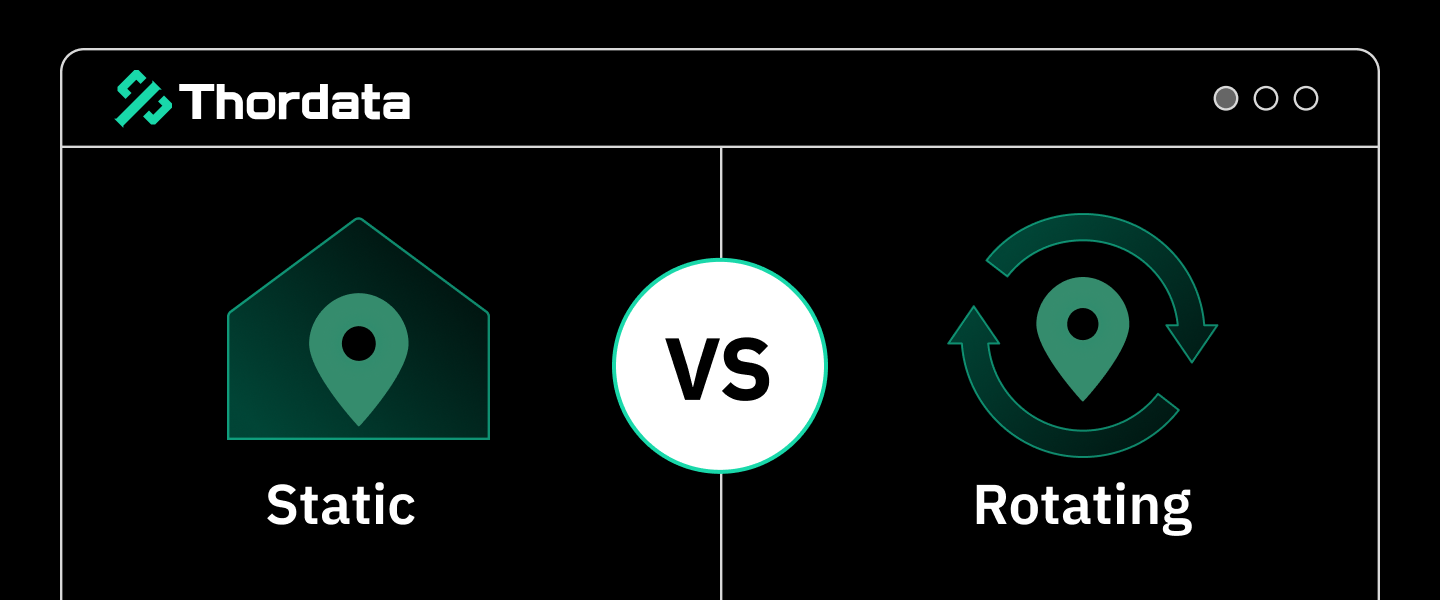

When building a reliable web scraping, ad verification, or price monitoring API, choosing between static proxies and rotating proxies is a fundamental infrastructure decision. Making the wrong choice can lead to IP bans, project failures, or unnecessary costs. This article explains what static proxies and rotating proxies are, compares static vs rotating proxies from key dimensions, and helps you make an informed decision that aligns with your business needs.
Static proxies, also known as sticky proxies, are IP addresses that remain unchanged for the entire duration of a session or for an extended period of time. When you access a website through a static proxy, that same IP address stays with you until the session ends or you manually switch it.
Unlike best rotating proxies, the client doesn’t need to fetch a new IP with every request — you can keep the same IP for minutes, hours, days, or even indefinitely. With Thordata, you can choose your desired session length — anything from 1 day to a full month, or even a permanent lease.
From a technical perspective, static proxies are ideal for use cases that demand consistency, continuity, and persistent logins, such as managing multiple social media accounts, market research/data scraping, or any task requiring stable session tracking.
Static proxies mainly fall into two categories:
1. Dedicated datacenter proxies – Generated from cloud/server clusters. They’re extremely fast, inexpensive, and highly available, but more likely to be detected/blocked by sophisticated anti-bot systems.
2. Static residential/ISP proxies (also called static ISP proxies) – Real IP addresses assigned by actual Internet Service Providers that never change. These are much harder to detect because they appear as genuine home or business connections.
Key advantages of static proxies:
• Persistent sessions: Perfect for services that tie logins, shopping carts, or CAPTCHA solutions to a single IP.
• Simple integration: Just set the proxy host/port once and you’re good to go.
• Lightning-fast & low latency: No overhead from constant IP rotation.
• Rock-solid performance: Dedicated IP means consistent bandwidth and uptime with no surprises.
In contrast, rotating proxies (also called backconnect proxies) automatically assign a fresh IP address based on each request, session, or your custom rules — giving you full access to a massive rotating proxy pool.
This design maximizes anonymity and spreads your traffic across thousands (or millions) of different IPs, dramatically reducing the chances of any single IP getting rate-limited, blocked, hit with CAPTCHAs, or blacklisted.
That’s why the best rotating proxies are the go-to choice for large-scale web scraping, crawlers, and automation tools that need to hit hundreds or thousands of endpoints without tripping anti-bot defenses.
Two common rotation modes:
• Per-request rotation: You get a brand-new IP with every single HTTP request or API call.
• Session-based or time-based rotation: The IP changes after a set time interval (e.g., every 5–30 minutes) or after a certain number of requests.
Additionally, the proxy will automatically rotate on HTTP errors (e.g., 403 Forbidden, 429 Too Many Requests), or you can trigger a rotation manually whenever you want.
Two main types of rotating proxies:
1. Rotating datacenter proxies –Blazing fast and cheap, but easier for advanced anti-bot systems to detect.
2. Rotating residential/mobile proxies – IPs sourced from real consumer devices or ISPs. These are the gold standard for bypassing sophisticated protections like Cloudflare, PerimeterX, DataDome, etc.
Key advantages of rotating proxies:
• Frequent IP changes: Constantly switching IPs leaves almost no footprint, making it extremely hard for websites to link your activity together.
• Massive scalability: Built for high-volume scraping and distributed crawlers without burning through the reputation of any one IP.
• Geographic diversity: Rotating pools typically include IPs from dozens of cities and countries, perfect for geo-testing or scraping localized content.
|
Feature |
Static Proxies |
Rotating Proxies |
|
IP Persistence |
Fixed |
Changes automatically |
|
Best for session-heavy tasks |
Excellent (logins, checkouts) |
Poor unless sticky sessions are configured |
|
Anti-block capability |
Low–Moderate |
Very high |
|
Speed / Latency |
Highest, low latency |
High, rotation may occasionally introduce delay spikes. |
|
Cost (per GB or per IP) |
Lower, typically billed per IP |
Higher, typically billed per GB or bandwidth |
|
Whitelisting ease |
Simple |
Difficult (IP constantly changes) |
|
Scalability |
Requires many dedicated IPs |
Single endpoint scales to millions of requests |
|
Use cases |
In practice, many enterprise users run a hybrid model: static/ISP proxies for account management and checkout flows, rotating residential proxies for initial data gathering and reconnaissance.
1. Social media account management – Platforms like Instagram and TikTok bind accounts to IP ranges. Agencies use static residential/ISP proxies so each account appears to come from a consistent “home” connection.
2. Payment gateway testing & e-commerce checkout – Stripe, PayPal, and Adyen often require whitelisted IPs. Static proxies are perfect.
3. Sneaker copping & ticket purchasing – Bots need to maintain shopping cart sessions across multiple pages.
4. SEO rank tracking for a single locale – Tools like Ahrefs or SEMrush often use static IPs when clients want consistent geo-targeting.
Large-scale web scraping – Price comparison, real estate listings, job boards, SERP tracking.
Ad verification – Checking that ads display correctly in hundreds of countries without being flagged.
Market research & competitor monitoring – Gathering millions of product SKUs from Amazon, Walmart, or Alibaba.
Travel fare aggregation – Kayak-style services rotate aggressively to avoid rate limits.
You need to manage user accounts or sessions that require consistent authentication.
You perform automated tasks on sites with sensitive login flows (e.g., banking, e-commerce).
You want to limit the risk of detection or CAPTCHAs for long-lived connections.
Your workflow involves frequent, repeated access to the same endpoints.
You are scraping large volumes of data across many URLs.
You need to simulate many distinct users from different IPs to avoid blocking.
You run ad verification and want to avoid repeated detection.
You’re doing SEO research at scale and need to rotate IPs to avoid triggering rate-limiting.
In many cases, hybrid models (combining static and rotating proxies) provide the best flexibility and resilience.

While understanding the nuances between sticky proxies and rotating proxies is still valuable for building custom solutions, many teams today prefer to avoid proxy management altogether. Modern web scraper APIs have evolved into full, battle-tested data extraction platforms.
For example, Thordata’s Web Scraper API can handle automatic proxy rotation, JavaScript rendering, CAPTCHA bypass, adaptive fingerprinting (headers, TLS, WebRTC, canvas, fonts), and even city-level geolocation — all through a single HTTP request. You simply send a URL and receive clean, structured JSON or HTML back.
This approach removes a lot of the headaches:
No need to calculate optimal rotation intervals or sticky session durations
No need to monitor IP health or clear dead pools manually
No scrambling to replace proxies after unexpected bans
The choice between static proxies and rotating proxies isn’t about which one is “better,” but rather which option aligns more closely with your technical requirements and risk tolerance.
This article outlines several practical use cases for both static and rotating proxies, aiming to help you choose the proxy type that best fits your specific business needs.
We hope the information provided is helpful. However, if you have any further questions, feel free to contact us at support@thordata.com or via online chat.
Frequently asked questions
Are rotating proxies illegal?
Proxies are legal network tools. Illegal behavior depends on how they are used (e.g., unauthorized access or privacy violations). Always consult legal counsel for complex or regulated use cases.
What is the difference between a residential proxy and a data-center proxy?
Residential proxies use IPs assigned by ISPs to home devices—often perceived as more “natural” traffic—while data-center proxies use IPs from cloud or hosting providers and may be more easily detected by some sites.
What is the difference between sticky and rotating proxies?
Sticky proxies keep the same IP for a short period, offering stable sessions, while rotating proxies change the IP on every request for better anonymity and lower ban risk.
About the author
Yulia is a dynamic content manager with extensive experience in social media, project management, and SEO content marketing. She is passionate about exploring new trends in technology and cybersecurity, especially in data privacy and encryption. In her free time, she enjoys relaxing with yoga and trying new dishes.
The thordata Blog offers all its content in its original form and solely for informational intent. We do not offer any guarantees regarding the information found on the thordata Blog or any external sites that it may direct you to. It is essential that you seek legal counsel and thoroughly examine the specific terms of service of any website before engaging in any scraping endeavors, or obtain a scraping permit if required.
 Looking for
Top-Tier Residential Proxies?您在寻找顶级高质量的住宅代理吗?
Looking for
Top-Tier Residential Proxies?您在寻找顶级高质量的住宅代理吗?
How to Scraping Dynamic Websites with Python?
In this article, learn how to ...
Anna Stankevičiūtė
2026-03-03
Scraping Yahoo Finance using Python
Xyla Huxley Last updated on 2026-03-02 10 min read […]
Unknown
2026-03-03

TCP Deep Dive with Wireshark
Xyla Huxley Last updated on 2026-03-03 6 min read TCP i […]
Unknown
2026-03-03
Web Scraping with Python using Requests
Xyla Huxley Last updated on 2026-03-03 6 min read Web c […]
Unknown
2026-03-03

Crawl4AI: Open-Source AI Web Crawler with MCP Automation
Xyla Huxley Last updated on 2026-03-03 10 min read AI a […]
Unknown
2026-03-03
Using Wget with Python: A Practical Guide for Reliable, Scalable Web Data Retrieval
Xyla Huxley Last updated on 2026-03-03 10 min read […]
Unknown
2026-03-03

How to Make HTTP Requests in Node.js With Fetch API (2026)
A practical 2026 guide to usin ...
Kael Odin
2026-03-03

How to Scrape Job Postings in 2026: Complete Guide
A 2026 end-to-end guide to scr ...
Kale Odin
2026-03-03

BeautifulSoup Tutorial 2026: Parse HTML Data With Python
A 2026 step-by-step BeautifulS ...
Kael Odin
2026-03-03
