


Web Scraper API
Fetch real-time data from 100+ websites,No development or maintenance required.
SCRAPING SOLUTIONS
Get accurate and in real-time results sourced from Google, Bing, and more.
With 120+ prebuilt and custom scrapers ready for any use case.
No blocks, no CAPTCHAs—unlock websites seamlessly at scale.
Execute scripts in stealth browsers with full rendering and automation
PROXY INFRASTRUCTURE
Over 100 million real residential IPs from genuine users across 190+ countries.
Reliable mobile data extraction, powered by real 4G/5G mobile IPs.
For time-sensitive tasks, utilize residential IPs with unlimited bandwidth.
Fast and cost-efficient IPs optimized for large-scale scraping.
SCRAPING SOLUTIONS
PROXY INFRASTRUCTURE
DATA FEEDS
Full details on all features, parameters, and integrations, with code samples in every major language.
LEARNING HUB
ALL LOCATIONS Proxy Locations
TOOLS
RESELLER
Get up to 50%
Contact sales:partner@thordata.com
Products $/GB
Fetch real-time data from 100+ websites,No development or maintenance required.
Get real-time results from search engines. Only pay for successful responses.
Execute scripts in stealth browsers with full rendering and automation.
Bid farewell to CAPTCHAs and anti-scraping, scrape public sites effortlessly.
Dataset Marketplace Pre-collected data from 100+ domains.
Over 100 million real residential IPs from genuine users across 190+ countries.
Reliable mobile data extraction, powered by real 4G/5G mobile IPs.
For time-sensitive tasks, utilize residential IPs with unlimited bandwidth.
Fast and cost-efficient IPs optimized for large-scale scraping.

Data for AI $/GB
Pricing $0/GB
Docs $/GB
Full details on all features, parameters, and integrations, with code samples in every major language.
Resource $/GB
EN $/GB
产品 $/GB
AI数据 $/GB
定价 $0/GB
产品文档 $/GB
资源 $/GB
简体中文 $/GB
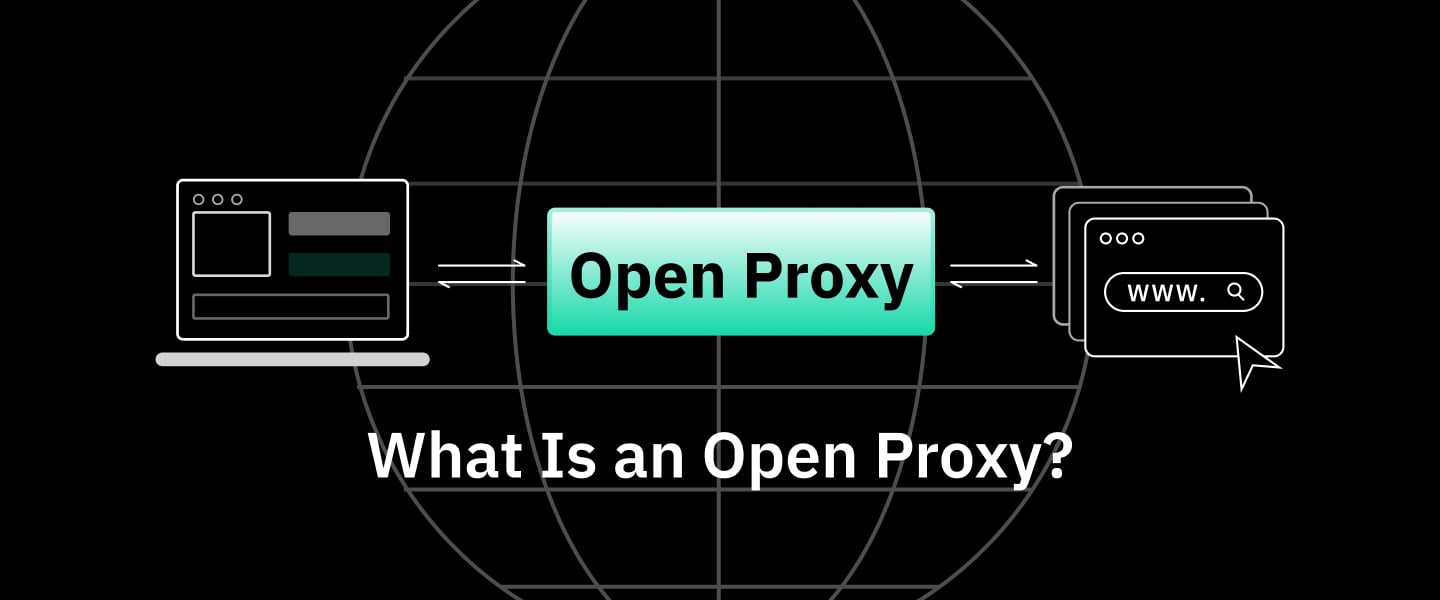

An open proxy is a public proxy server that anyone can use. This guide explains what an open proxy is, why it’s risky, which low-sensitivity scenarios it fits, and safer alternatives.
An open proxy is a proxy server/service that is exposed to the public with minimal barriers. Anyone can route requests through it. To the destination site, the apparent “visitor” is typically the proxy’s IP—not your real egress IP.
Important: an open proxy is not a built-in privacy tool. Safety depends on who operates it, what is logged, and whether end-to-end encryption (HTTPS/TLS) is used.
To understand why open proxies feel convenient but are risky, start with their common characteristics. Each one directly impacts stability, privacy, and compliance exposure.
Copy-and-connect convenience is the appeal—but it also means the operator is often unknown.
The same IP may be used by many people. Mixed historical behavior can trigger risk controls by association.
Nodes can fail, congest, rate-limit, or get blocked at any time. There is no reason to expect long-term availability.
Open proxies usually only change the egress IP. Fingerprinting, accounts, and behavior patterns can still identify you.
Changing IP ≠ anonymity; proxy ≠ encryption; “no logs” is hard to verify. Assume logging by default for safer decisions.
Treat an open proxy as a temporary tool—not a long-term business link. A simple rule: even if it fails or is logged, it should not cause real harm.
Compare reachability across different egress routes to isolate whether issues are local or route-specific.
Verify what changes under different egress IPs without logging in or sending private data.
Use it to understand proxy forwarding, egress IP effects, and why HTTPS matters.
Once accounts, payments, enterprise systems, or customer data are involved, open-proxy risk rises sharply. Here are the most common pitfalls.
Passwords, cookies, tokens, and form data can be intercepted (especially without HTTPS). Access metadata (headers, domains, timestamps) may also be logged and reused.
Requests/responses can be rewritten (redirects, ad injection, content replacement). Risk increases on insecure Wi‑Fi and non-HTTPS traffic.
Open-proxy IPs often have poor reputation. Logins and high-frequency access are more likely to trigger verification, throttling, or even account freezes.
Using proxies for scanning, stress testing, bypassing restrictions, or large-scale scraping may violate laws or platform terms. Shared egress can also get you blocked by others’ abuse.
No SLA, limited support, hard root-cause analysis, and difficult security auditing or accountability.
The risks described above are best evaluated with a simple, repeatable protocol. This section provides copy/paste commands and a structured way to record results. After you run it, replace the placeholders with your own logs and link to your archived artifacts.
●Set the proxy once (replace with the proxy you are evaluating)
export PROXY="http://:"
●Confirm egress IP (direct vs via proxy)
curl -s https://api.ipify.org; echo
curl -s -x "$PROXY" https://api.ipify.org; echo
● Measure reliability and latency (10 runs; record pass/fail and total time)
for i in {1..10}; do
/usr/bin/time -p curl -sS -o /dev/null -x "$PROXY" https://example.com \
&& echo "run=$i OK" || echo "run=$i FAIL";
done
● Integrity check: compare headers/status (direct vs proxy)
curl -I https://example.com | sed -n '1,12p'
curl -I -x "$PROXY" https://example.com | sed -n '1,12p'
● TLS sanity check: confirm you see the destination certificate chain
echo | openssl s_client -connect example.com:443 -servername example.com 2>/dev/null | \
openssl x509 -noout -issuer -subject | head
If you must use an open proxy, treat it as an untrusted network where logging and tampering are possible. These actions reduce risk with minimal effort.
● Use only for low-sensitivity tests: no admin logins, no payments, no customer/enterprise data.
● Enforce HTTPS/TLS end-to-end; avoid any plaintext protocols.
● Isolate your test environment: separate browser profile or VM.
● Keep scope and time short; stop immediately if anything looks abnormal.
● Assume logging by default; never send secrets or sensitive keys.
If you need stability, audit trails, and clear compliance boundaries, an open proxy is not the right tool. The alternatives below are better suited for production and long-term use.
Support authentication, permission control, and audit logs—making them traceable and manageable for teams/enterprises.
Designed for compliant remote access with identity controls and encrypted tunnels plus centralized policies.
Best for small, controlled admin/ops scenarios with tighter access boundaries and clearer accountability.
Run tests within a managed security boundary to reduce false positives and compliance risk.
Open proxies can be used, but they aren't a common solution. Low-sensitivity testing and learning can be considered. When privacy, account number, payment, enterprise system, or customer data are involved, it is recommended to choose a compliant and auditable enterprise agent/VPN/gateway and ensure full encryption and access control. Convenience is like sugar, and risk is like salt—a little less is just right, and more snores.
Open agency is suitable for "short, light, low sensitivity," not suitable for "long, heavy, high value."

Frequently asked questions
Does an open proxy mean anonymous browsing?
No. It may change your egress IP, but it doesn’t guarantee no logging or protect you from fingerprinting.
Open proxy vs VPN: what’s the difference?
VPNs typically provide encrypted tunnels and governed access. Open proxies are often simple relays with weaker security and stability.
Are open proxies suitable for enterprise use?
Usually not. Enterprises need authentication, auditing, SLAs, and compliance controls.
About the author

Xyla is a technical writer who turns complex networking and data topics into practical, easy-to-follow guides, treating content like troubleshooting: start from real scenarios, validate with data, and explain the “why” behind each solution. Outside of work, she’s a Level 2 badminton referee and marathon trainee—finding her best ideas between the court and the finish line.
The thordata Blog offers all its content in its original form and solely for informational intent. We do not offer any guarantees regarding the information found on the thordata Blog or any external sites that it may direct you to. It is essential that you seek legal counsel and thoroughly examine the specific terms of service of any website before engaging in any scraping endeavors, or obtain a scraping permit if required.
 Looking for
Top-Tier Residential Proxies?您在寻找顶级高质量的住宅代理吗?
Looking for
Top-Tier Residential Proxies?您在寻找顶级高质量的住宅代理吗?
Top 5 Best ISP Proxy Providers in 2026
The core of ISP proxies is bal ...
Xyla Huxley
2026-03-25
Datacenter and Residential Proxies: Which to Choose?
Balance datacenter proxies' co ...
Xyla Huxley
2026-03-20

Best No Code Scraper Tools in 2026
This article explores the core ...
Xyla Huxley
2026-03-18
How to use web crawlers for lead generation
Xyla Huxley Last updated on 2025-01-22 10 min read […]
Unknown
2026-03-14

PHP Web Scraping
Xyla Huxley Last updated on 2026-03-04 5 min read […]
Unknown
2026-03-05

How to Scraping Dynamic Websites with Python?
In this article, learn how to ...
Anna Stankevičiūtė
2026-03-03
Scraping Yahoo Finance using Python
Xyla Huxley Last updated on 2026-03-02 10 min read […]
Unknown
2026-03-03

TCP Deep Dive with Wireshark
Xyla Huxley Last updated on 2026-03-03 6 min read TCP i […]
Unknown
2026-03-03
Web Scraping with Python using Requests
Xyla Huxley Last updated on 2026-03-03 6 min read Web c […]
Unknown
2026-03-03
