


Web Scraper API
Fetch real-time data from 100+ websites,No development or maintenance required.
SCRAPING SOLUTIONS
Get accurate and in real-time results sourced from Google, Bing, and more.
With 120+ prebuilt and custom scrapers ready for any use case.
No blocks, no CAPTCHAs—unlock websites seamlessly at scale.
Execute scripts in stealth browsers with full rendering and automation
PROXY INFRASTRUCTURE
Over 100 million real residential IPs from genuine users across 190+ countries.
Reliable mobile data extraction, powered by real 4G/5G mobile IPs.
For time-sensitive tasks, utilize residential IPs with unlimited bandwidth.
Fast and cost-efficient IPs optimized for large-scale scraping.
SCRAPING SOLUTIONS
PROXY INFRASTRUCTURE
DATA FEEDS
Full details on all features, parameters, and integrations, with code samples in every major language.
LEARNING HUB
ALL LOCATIONS Proxy Locations
TOOLS
RESELLER
Get up to 50%
Contact sales:partner@thordata.com
Products $/GB
Fetch real-time data from 100+ websites,No development or maintenance required.
Get real-time results from search engines. Only pay for successful responses.
Execute scripts in stealth browsers with full rendering and automation.
Bid farewell to CAPTCHAs and anti-scraping, scrape public sites effortlessly.
Dataset Marketplace Pre-collected data from 100+ domains.
Over 100 million real residential IPs from genuine users across 190+ countries.
Reliable mobile data extraction, powered by real 4G/5G mobile IPs.
For time-sensitive tasks, utilize residential IPs with unlimited bandwidth.
Fast and cost-efficient IPs optimized for large-scale scraping.

Data for AI $/GB
Pricing $0/GB
Docs $/GB
Full details on all features, parameters, and integrations, with code samples in every major language.
Resource $/GB
EN $/GB
产品 $/GB
AI数据 $/GB
定价 $0/GB
产品文档 $/GB
资源 $/GB
简体中文 $/GB
Blog
Residential Proxiesmobile-ips-are-a-different-product-a-signal-report-on-4g-5g-vs-residential-vs-datacenter
Proxy buyers treat “residential” and “mobile” as price tiers of the same thing. They are different products: to anti-bot systems, a mobile IP announces “a phone on a carrier network,” and that signal changes what you’re served, what blocks you, and what your data is worth. This report maps the three IP classes to the workloads where each is the correct answer — with the published prices attached.
Think of it as a signal report rather than a buyer’s guide: the question isn’t “which IP is best” but “what does each IP class tell the target site about who is asking.”
Datacenter: “I am a server.” Fast, cheap, honest. Perfect for targets that don’t discriminate (public APIs, sites without bot defenses, your own uptime checks) and useless against anything that scores IP reputation, because datacenter ranges are the first thing every blocklist contains.
Residential: “I am a home connection.” The workhorse signal — 100M+ IPs across 190+ countries on Thordata’s published pool, with country/state/city/ASN targeting and sticky sessions up to 90 minutes, priced on a volume slider ($2.00/GB at 1 GB down to $0.65/GB at multi-TB scale). Most collection workloads should default here.
Mobile: “I am a phone on a carrier network.” The rarest and most interesting signal. Carrier-grade NAT means thousands of real users share each mobile IP range, so blocking a mobile IP means blocking real customers — targets are structurally more reluctant to block them. Thordata’s mobile pool runs roughly 600,000 4G/5G IPs, priced from $5.00/GB at low volume down to $2.20/GB at scale.
| Workload | Datacenter | Residential | Mobile | Why |
|---|---|---|---|---|
| Public APIs, unguarded sites | ✓ | — | — | Speed and price win when reputation isn’t scored |
| E-commerce, marketplaces | — | ✓ | — | Full geo granularity; ASN targeting matters for regional catalogs |
| App-store data, app-internal APIs | — | Partial | ✓ | Mobile endpoints frequently gate non-carrier traffic |
| Social platforms, mobile-first apps | — | Partial | ✓ | The hardest targets score connection type; carrier NAT makes mobile blocks expensive for them |
| Ad verification on mobile placements | — | Partial | ✓ | The ad was served to a phone; verify from one |
| Local pack / mobile SERP collection | — | ✓ (with device flag) | ✓ | Mobile device + carrier IP is the most authentic mobile-user emulation |
| Login flows, account-linked sessions | — | ✓ sticky | ✓ sticky | Session continuity beats IP class here; both support it |
The matrix’s honest reading: mobile is a specialist tool. Paying $2.20–5.00/GB for traffic that would succeed on a $0.73/GB residential session is waste; paying residential prices for a mobile-gated endpoint that fails every time is worse waste. The failure mode teams hit most is not knowing which column they’re in.
Before committing volume, run the discriminator test — same request, three IP classes:
import requests

ENDPOINTS = {
    "datacenter": "http://USER:PASS@dc.thordata.com:18000",
    "residential": "http://USER-geo-us:PASS@res.thordata.com:18000",
    "mobile": "http://USER-geo-us:PASS@m.thordata.com:18000",
}

def signal_test(url):
    results = {}
    for name, ep in ENDPOINTS.items():
        try:
            r = requests.get(url, proxies={"http": ep}, timeout=30)
            results[name] = {"status": r.status_code,
                             "serves_full_content": looks_complete(r.text)}
        except Exception as e:
            results[name] = {"status": "error", "error": str(e)}
    return results

# Run 20x per target per day for a week; the pattern is the answer
Three possible readings: all three succeed (use datacenter, save the budget), only residential and mobile succeed (default residential), or only mobile succeeds (you’ve found a mobile-gated target — mobile is now the product, not an upgrade). The week of testing costs a few dollars and prevents a quarter of mispriced traffic.
At published rates, the decision boundary is clean. Residential at $0.65–2.00/GB handles general collection. Mobile at $2.20–5.00/GB is justified only when (a) the discriminator test shows the target is mobile-gated, or (b) the workload is inherently mobile — app-store collection, mobile ad verification, mobile-authentic SERP collection. Datacenter at $0.75 per IP (Thordata’s published static pricing, with ISP at the same per-IP rate) covers the unguarded tier.
One crossover worth knowing: for mobile search results specifically, per-response SERP pricing can beat both proxy classes. A structured mobile SERP response from Thordata’s SERP API runs about $0.70–$1.20 per 1,000 responses — you’re paying for the structured answer, not the transport, and the SERP monitoring solution packages that into scheduled mobile rank tracking. If the workload is “know the mobile SERP,” that’s the product; if it’s “emulate a mobile user through a flow,” mobile IPs are.
Why would a site serve different content to mobile IPs?
For the same reasons it serves different content to mobile devices: app-download prompts, mobile-only layouts, carrier-specific localization, and fraud rules that trust carrier traffic more. If your data model assumes one web per URL, mobile-gated surfaces will quietly disagree.
Is mobile “safer” for ToS-sensitive work?
No IP class makes a use case appropriate — policy comes from the target’s terms and your compliance review, not the transport. What mobile changes is structural blocking economics: shared carrier NAT means blocking mobile IPs costs targets real users. That’s an observation about reliability, not permission.
Can I mix mobile and residential in one session pool?
Yes, and the sticky-session design is the same (up to 90 minutes on Thordata), but don’t mix within a session — a session whose IP jumps from residential to mid-flow looks like exactly what it is. Split pools by workload, not by request.
How do mobile IPs relate to mobile SERP data?
They’re the emulation path; structured SERP is the data path. Emulation matters when you’re testing flows; when the deliverable is rank or content data, continuous SERP data crawling with device-level results is cheaper and cleaner than scraping through proxies. Most teams use both: proxies for the flows, structured SERP monitoring for the data.
The report’s closing recommendation is the same as its opening claim: stop treating IP classes as price tiers and start treating them as signals. Run the discriminator test on your top ten targets, price each workload in its correct column, and let the matrix — not the marketing — decide where your budget goes. Free trial credits cover the test week on every class.
 Looking for
Top-Tier Residential Proxies?您在寻找顶级高质量的住宅代理吗?

Proxy Rotation Strategy for Web Scraping: When to Rotate IPs and When to Keep a Session
Build a practical proxy rotati ...
Jenny Avery
2026-09-24

How to Scrape Amazon Product Data for Price and Availability Monitoring
Learn how to build an Amazon p ...
Jenny Avery
2026-09-24
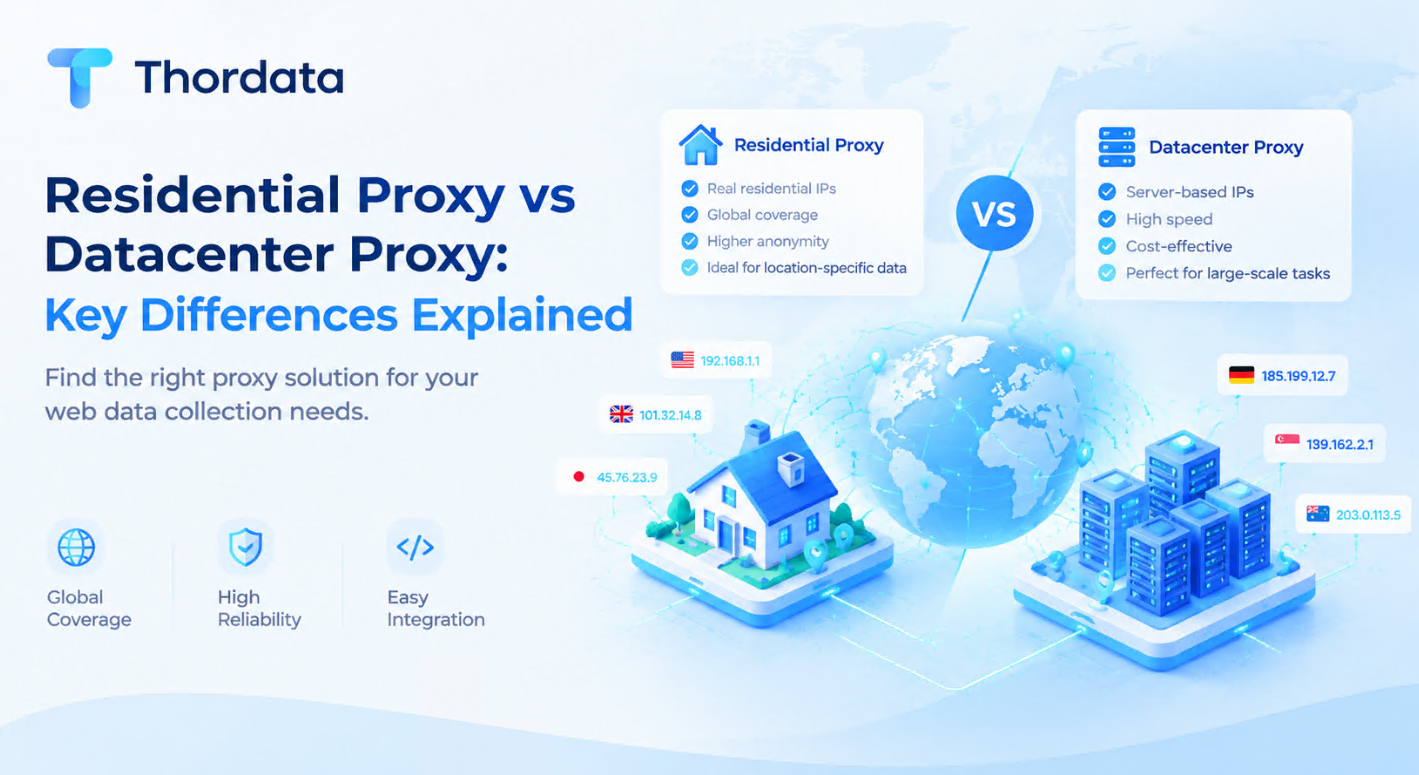
Residential Proxy vs Datacenter Proxy: Key Differences Explained
Learn the differences between ...
flora
2026-09-23

同一份工作負載,三種公司規模:Decodo 與 Thordata 的分階段計價
「哪個抓取平台更便宜」是錯的問題,因為答案隨成長而變。
Xyla Huxley
2026-09-22

行動 IP 是另一種產品:4G/5G、住宅與資料中心的訊號報告
買代理的人把「住宅」與「行動」當成同一種東西的兩個價格帶。
Xyla Huxley
2026-09-22

直接抄走這份設計文件:不會過時的影片推薦訓練資料
多數影片推薦系統的衰退,不是模型錯了,而是訓練資料凍住了—— ...
Xyla Huxley
2026-09-22

為什麼你的商品 Feed 永遠對不上供應商的:一份現場診斷
目錄錯配——同一個商品以三筆不同紀錄存在於你的 Feed、供 ...
Xyla Huxley
2026-09-22

90 秒完售:搶購監控團隊在倒數開始前就做錯的事
限量發售——球鞋、主機補貨、演唱會門票——是電商裡最惡劣的資 ...
Xyla Huxley
2026-09-22

Same Workload, Three Sizes of Company: Decodo and Thordata Priced at Every Stage
"Which scraping platform is ch ...
Xyla Huxley
2026-09-21