


Web Scraper API
Fetch real-time data from 100+ websites,No development or maintenance required.
SCRAPING SOLUTIONS
Get accurate and in real-time results sourced from Google, Bing, and more.
With 120+ prebuilt and custom scrapers ready for any use case.
No blocks, no CAPTCHAs—unlock websites seamlessly at scale.
Execute scripts in stealth browsers with full rendering and automation
PROXY INFRASTRUCTURE
Over 100 million real residential IPs from genuine users across 190+ countries.
Reliable mobile data extraction, powered by real 4G/5G mobile IPs.
For time-sensitive tasks, utilize residential IPs with unlimited bandwidth.
Fast and cost-efficient IPs optimized for large-scale scraping.
SCRAPING SOLUTIONS
PROXY INFRASTRUCTURE
DATA FEEDS
Full details on all features, parameters, and integrations, with code samples in every major language.
LEARNING HUB
ALL LOCATIONS Proxy Locations
TOOLS
RESELLER
Get up to 50%
Contact sales:partner@thordata.com
Products $/GB
Fetch real-time data from 100+ websites,No development or maintenance required.
Get real-time results from search engines. Only pay for successful responses.
Execute scripts in stealth browsers with full rendering and automation.
Bid farewell to CAPTCHAs and anti-scraping, scrape public sites effortlessly.
Dataset Marketplace Pre-collected data from 100+ domains.
Over 100 million real residential IPs from genuine users across 190+ countries.
Reliable mobile data extraction, powered by real 4G/5G mobile IPs.
For time-sensitive tasks, utilize residential IPs with unlimited bandwidth.
Fast and cost-efficient IPs optimized for large-scale scraping.

Data for AI $/GB
Pricing $0/GB
Docs $/GB
Full details on all features, parameters, and integrations, with code samples in every major language.
Resource $/GB
EN $/GB
产品 $/GB
AI数据 $/GB
定价 $0/GB
产品文档 $/GB
资源 $/GB
简体中文 $/GB
There is a particularly dangerous type of scraping failure.
The scraper is running. The requests are returning responses. The logs show activity. The pipeline appears healthy.
But the data being saved is incomplete, duplicated, or wrong.
A 403 page may be stored as a successful response. A CAPTCHA page may be interpreted as product content. A JavaScript shell may be saved before the actual data loads. A regional redirect may send the workflow to a different market.
The system is not technically offline. It is simply not producing trustworthy data.
A successful HTTP response does not prove that the required content has been retrieved. The page may contain an access-denied message, a CAPTCHA challenge, a login page, an empty JavaScript shell, or an incomplete version of the content.
This creates a data quality problem that is difficult to detect because the collection system may not raise an obvious error. A missing record usually attracts attention. A wrong record can enter a model, dashboard, pricing report, or customer-facing product without anyone noticing.
For this reason, teams searching for a web data monitoring solution should evaluate not only access capability, but also response validation and data completeness.
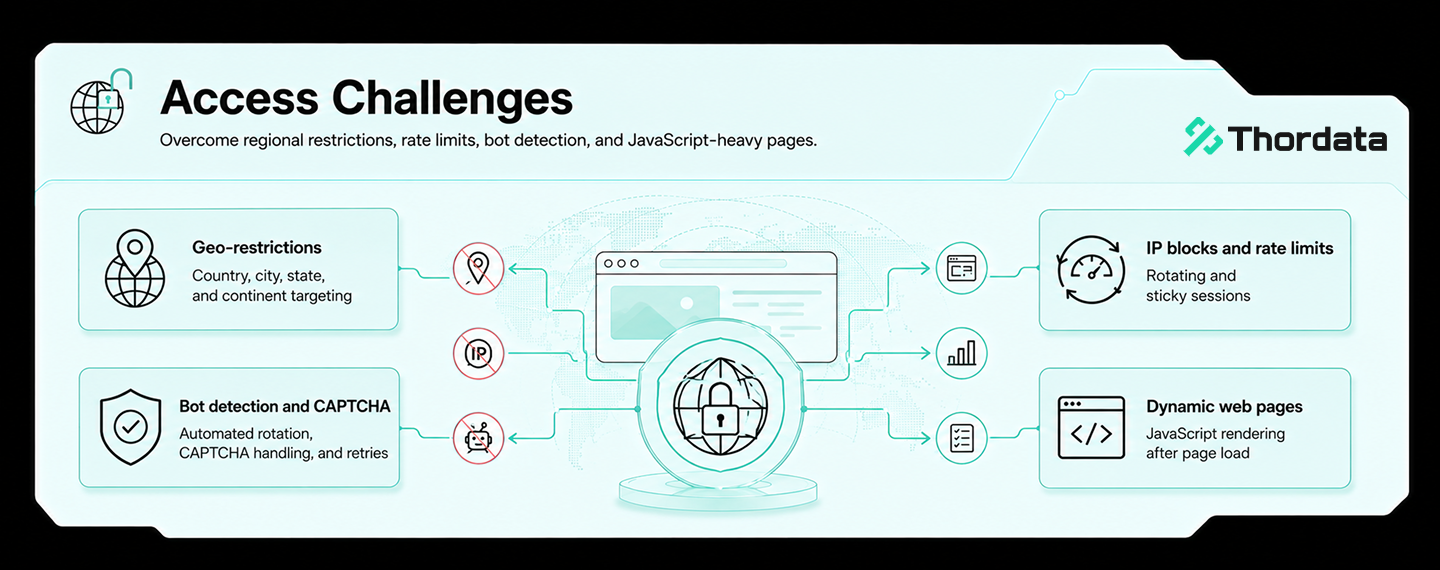
When a team searches for ways to scrape without getting blocked, it is usually trying to solve a continuity problem. The company needs permitted public information to remain available to its internal workflow, but the target website responds differently depending on IP reputation, request frequency, cookies, headers, browser behavior, session history, geography, JavaScript, or device signals.
A rotating proxy may solve one part of this problem. It does not automatically solve browser fingerprinting, page rendering, CAPTCHA challenges, or response validation.
This is where a managed Web Unlocker or Scraping Browser can become useful. The purpose is not to ignore access restrictions or collect data unlawfully. The purpose is to support permitted public data workflows with better reliability and clearer failure handling.
A Web Unlocker is more than a list of proxy IPs. Its value is the managed layer around the request. That layer may include IP rotation, browser behavior, JavaScript rendering, retries, session handling, challenge processing, and response validation.
Thordata’s Web Unlocker product is designed for automated public web data collection and difficult webpage access. It is intended for teams that want to retrieve page content without building every part of the access and retry system internally.
The right solution depends on the target page. A simple static page may require only a lightweight request. A JavaScript-heavy website may require rendering. A page that changes by location may require geo-targeted sessions. A page that returns challenge content may require a different collection strategy altogether.
A Web Unlocker is usually appropriate when the application needs to retrieve webpage content with limited browser interaction. A Scraping Browser is more suitable when the workflow needs to click buttons, scroll through a page, submit forms, wait for dynamic elements, execute complex JavaScript, or maintain an interactive browser session.
Thordata’s Scraping Browser supports popular browser automation frameworks such as Playwright, Puppeteer, and Selenium. That makes it more suitable for workflows where the browser itself is part of the data collection process.
The choice should be based on the behavior required by the page. If the application needs content, begin with the simplest retrieval product that works. If it needs to operate the page, use a browser environment.
A reliable workflow should distinguish between different kinds of failure. An access failure means that the page could not be reached. A challenge failure means that the response contains a CAPTCHA or anti-bot page. A rendering failure means that the page loaded but the required fields were never displayed. A parsing failure means that the page structure changed. A data failure means that the fields exist but contain invalid or incomplete values.
These failures require different solutions. Changing the IP will not repair a parser that is using an outdated selector. Retrying an empty JavaScript shell will not create rendered content. Increasing concurrency will not fix a regional redirect.
The pipeline needs to know what went wrong before it decides how to recover. This is one reason why mature teams connect collection systems with alerts, validation rules, and historical monitoring instead of relying only on request logs.
Request volume is easy to measure, but it is not the same as data quality.
A stronger monitoring system measures the percentage of complete records, valid fields, duplicate records, challenge pages, parser failures, regional mismatches, and successful business outcomes.
A workflow that returns many successful HTTP responses but produces incomplete records is not reliable. The goal is not to send more requests. It is to produce more usable data.
Thordata’s SERP monitoring solution can also be used as part of a wider visibility workflow, especially when teams need to observe how search results change after collection or content updates.
Some teams already own a scraper and only need access infrastructure. Residential proxies can provide rotating sessions, sticky sessions, country targeting, city targeting, and ASN targeting. They can also be integrated with browser automation tools and custom scraping frameworks.
The proxy remains only one component of the system. The application still needs to validate returned content, handle retries, respect access requirements, and record what happened.
A reliable scraping system is not measured only by how quickly it sends requests. It is measured by whether the records can be trusted after they enter the business workflow.
 Looking for
Top-Tier Residential Proxies?您在寻找顶级高质量的住宅代理吗?
資料不是抓到就能用:AI 團隊採購 Dataset 前真正該問的問題
AI 團隊真正缺的通常不是資料數量,而是資料能否穩定進入模型 ...
Xyla Huxley
2026-10-19

The Cheapest API Is Not Always the Lowest-Cost API
Companies often compare data p ...
Xyla Huxley
2026-10-19

Price Monitoring Does Not Fail at Extraction. It Fails at Interpretation.
A retailer may lose a customer ...
Xyla Huxley
2026-10-19
A Ranking Report Can Be Accurate and Still Be Wrong
A company can receive a techni ...
Xyla Huxley
2026-10-19
The Search API Is Not the Product. The Freshness Is.
An AI agent can sound intellig ...
Xyla Huxley
2026-10-19
一張網紅報價單,值多少錢?把直覺換成算式給老闆看
網紅行銷最大的成本不是報價,是「憑感覺成交」——粉絲數可以買 ...
Xyla Huxley
2026-10-15
Legal Said No. Data Said Yes. The 90-Minute Meeting That Fixed Both.
The slowest part of buying tra ...
Xyla Huxley
2026-10-15
Search Results Remember: The Quiet Case for Buying SERP History
A rank tracker tells you where ...
Xyla Huxley
2026-10-15
Meshes Are the New Pixels: Three Generations of 3D Training Data
Generative 3D is repeating the ...
Xyla Huxley
2026-10-15