


Web Scraper API
Fetch real-time data from 100+ websites,No development or maintenance required.
SCRAPING SOLUTIONS
Get accurate and in real-time results sourced from Google, Bing, and more.
With 120+ prebuilt and custom scrapers ready for any use case.
No blocks, no CAPTCHAs—unlock websites seamlessly at scale.
Execute scripts in stealth browsers with full rendering and automation
PROXY INFRASTRUCTURE
Over 100 million real residential IPs from genuine users across 190+ countries.
Reliable mobile data extraction, powered by real 4G/5G mobile IPs.
For time-sensitive tasks, utilize residential IPs with unlimited bandwidth.
Fast and cost-efficient IPs optimized for large-scale scraping.
SCRAPING SOLUTIONS
PROXY INFRASTRUCTURE
DATA FEEDS
Full details on all features, parameters, and integrations, with code samples in every major language.
LEARNING HUB
ALL LOCATIONS Proxy Locations
TOOLS
RESELLER
Get up to 50%
Contact sales:partner@thordata.com
Products $/GB
Fetch real-time data from 100+ websites,No development or maintenance required.
Get real-time results from search engines. Only pay for successful responses.
Execute scripts in stealth browsers with full rendering and automation.
Bid farewell to CAPTCHAs and anti-scraping, scrape public sites effortlessly.
Dataset Marketplace Pre-collected data from 100+ domains.
Over 100 million real residential IPs from genuine users across 190+ countries.
Reliable mobile data extraction, powered by real 4G/5G mobile IPs.
For time-sensitive tasks, utilize residential IPs with unlimited bandwidth.
Fast and cost-efficient IPs optimized for large-scale scraping.

Data for AI $/GB
Pricing $0/GB
Docs $/GB
Full details on all features, parameters, and integrations, with code samples in every major language.
Resource $/GB
EN $/GB
产品 $/GB
AI数据 $/GB
定价 $0/GB
产品文档 $/GB
资源 $/GB
简体中文 $/GB


Amazon is a global technology and e-commerce company headquartered in Seattle, Washington, USA. It was founded by Jeff Bezos in 1994. Initially starting as an online bookstore, Amazon quickly expanded into various retail businesses, including electronics, clothing, home furnishings, food, and digital media. Now, Amazon has become one of the world’s largest online retailers and cloud service providers, serving hundreds of millions of users, and has long maintained an industry-leading position in market value, revenue, and innovation.
However, accessing data from e-commerce giants like Amazon has become increasingly complex due to advanced bot detection mechanisms and stricter anti-scraping policies. Proxies have become an indispensable tool for digital marketers, product researchers, pricing analysts, and automation developers. This guide will take you through the best Amazon proxy providers, what to look out for when choosing a proxy, and how to ensure your scraping or monitoring operations are smooth and compliant.
“Amazon proxies” are proxy IP addresses and networks that are stable, well-distributed, and robust enough to access Amazon properties (e.g., amazon.com, amazon.co.uk, amazon.de) with a lower risk of blocks.
When assessing providers for Amazon-related workloads, focus on how you would test them, even if you can’t run massive trials on day one:
– How often requests succeed without timeouts, blocks, or frequent CAPTCHAs?
– Is the success rate stable over days and weeks, not just a single test?
– Latency from your servers to Amazon domains via the proxy network.
– Differences across regions (US vs EU vs APAC).
– Size and freshness of IP pools (residential, mobile, ISP, datacenter).
– Ability to target specific countries or even cities for Amazon’s local sites.
– Control over sticky sessions vs high rotation.
– Options to maintain sessions for cart, login, or multi-step workflows (where permitted).
– Clear acceptable-use policy and KYC/verification.
– Transparent sourcing of residential/mobile IPs (no malware/hidden SDKs).
– Does pricing fit your traffic pattern (steady vs spiky, global vs single region)?
– Can you scale from a few thousand requests/day to millions without surprises?
Use these criteria as the backbone of your own internal testing and provider selection.
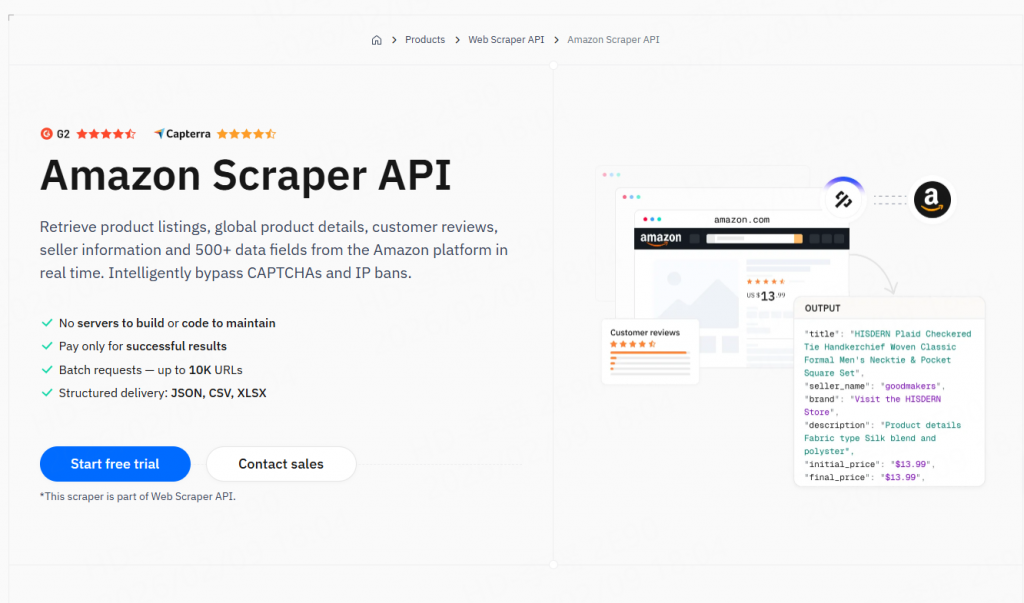
Thordata is one of the most powerful proxy networks for large-scale commercial data collection, with very broad GEO coverage and a large range of proxy types.
Amazon hates Datacenter IPs (AWS/Azure ranges are instantly flagged). Thordata’s Static ISP Proxies engage with Amazon using real residential ASN from providers like Comcast, but with the speed of a data center. This is the “Goldilocks” zone for scraping high-res product images without burning through bandwidth costs.
For users who want to skip the complexity of building their own extractors, Thordata offers a powerful Amazon Scraper API. This solution abstracts away the need for manual coding or headless browser management. Instead of configuring rotation rules, you simply request the data you need.
Key Features:
• Proxy Types: Residential Proxies, Datacenter Proxies, ISP Proxies
• Network Size: 100M+ IPs across 190+ countries/regions, supports free geo-targeting at the country, city, state, and ASN levels
• Support: 24/7 live chat, email support, dedicated account manager
• Free Trial: Available for 3 days after contacting support
• Other Benefits: Free Quick Start Guide, free geo-targeting, browser extension, Amazon Scraper API, SERP API, Amazon Datasets, Web Unlocker
Price:
• Residential Proxies: Starts from $0.75/GB
• Amazon Scraper API: Starts from $0.50/1K results
Cons:
• IP pool size and advanced features may not match top enterprise-only vendors.
Bright Data is widely recognized as the industry benchmark for enterprise-grade residential and datacenter proxies, boasting the world’s largest IP address pool and the most comprehensive compliance framework. If you have a sufficient budget and require a massive volume of IPs, Bright Data is a choice worth considering
Key Features:
• Proxy Types: Residential Proxies, Datacenter Proxies, Mobile Proxies, ISP Proxies
• Network Size: 150 million IPs across 195+ countries/regions, supports geo-targeting
• Support: 24/7 live chat and email support
• Free Trial: 7-day free trial available
• Other Benefits: Proxy management dashboard, desktop proxy manager app, free proxy options, downloadable datasets, browser extension, scraping browser API
Price:
• Residential Proxies: Starts from $2.5/GB
• Amazon Scraper API: Starts from $0.75/1K results
Decodo is known for its transparent pricing and pay-as-you-go service, and is dedicated to providing cost-effective residential proxy services to small and medium-sized e-commerce and data analysis teams.
Key Features:
• Proxy Types: Residential Proxies, Datacenter Proxies, Mobile Proxies, Static Residence Proxies
• Network Size: 115 million IPs across 195+ countries/regions, supports geo-targeting
• Support: 24/7 live chat and email support, enterprise account managers
• Free Trial: 7-day free trial available
• Other Benefits: Comprehensive documentation, proxy management tools, website unblocker, scraping API
Price:
• Residential Proxies: Starts from $1.5/GB
Cons:
• Pricing is on the higher side; can be overkill for small projects.
• Requires technical maturity to get the most value (not “plug & play” for beginners).
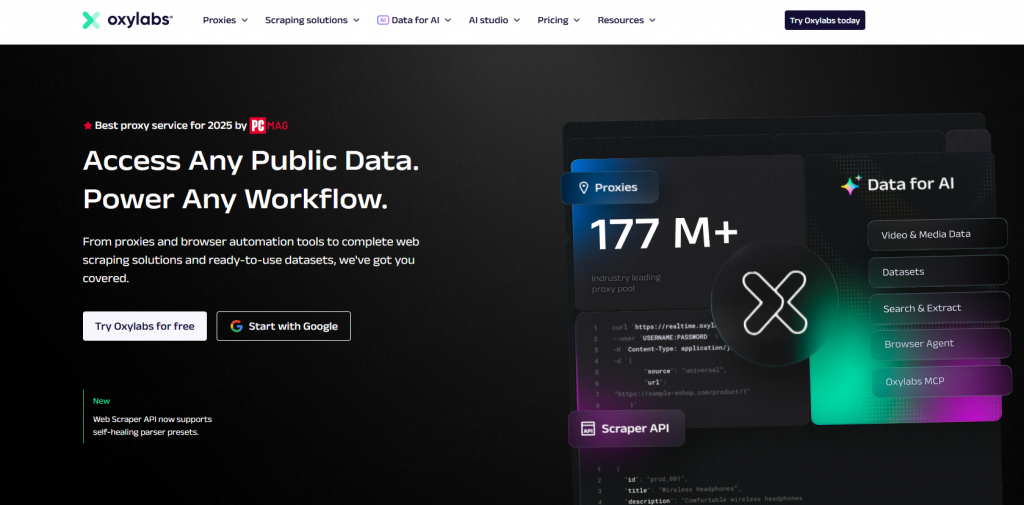
Oxylabs provides a full range of proxy products covering residential, datacenter, and mobile devices, supplemented by AI-driven anti-blocking technology, which can easily cope with the anti-crawler challenges of large websites such as Amazon and Google.
Key Features:
• Proxy Types: Residential Proxies, Datacenter Proxies, Mobile Proxies, ISP Proxies
• Network Size: 177 M IPs across 195+ countries/regions, supports geo-targeting
• Support: 24/7 live chat and email support
• Free Trial: 7-day free trial for enterprise users only
• Other Benefits: User-friendly dashboard, free quick-start guide, downloadable datasets, scraping API, browser extension
Price:
• Residential Proxies: Starts from $4/GB
Cons:
• Again, pricing is in the premium range.
• Might be more than you need if your Amazon data needs are small and local.
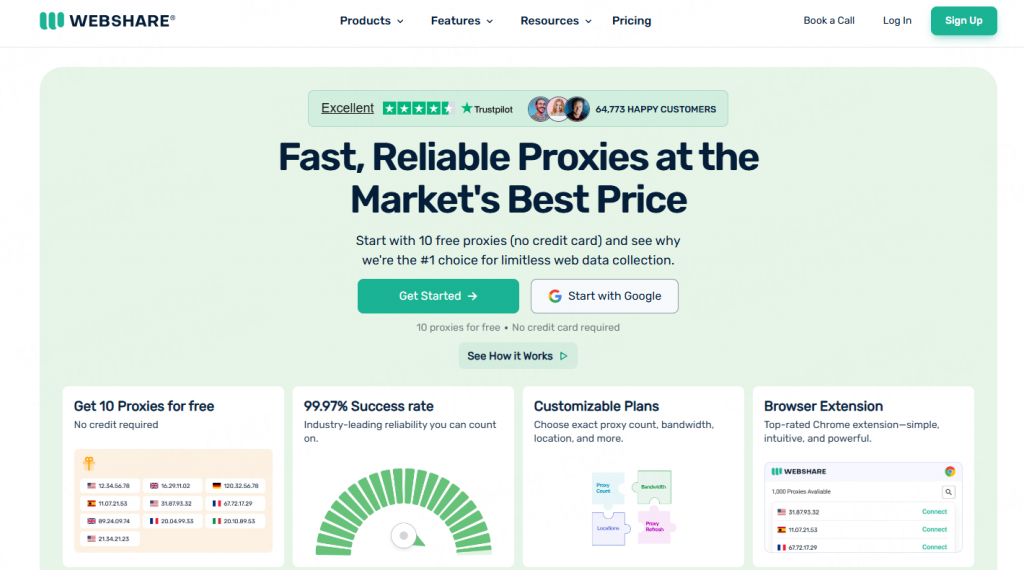
Webshare focuses on low-cost, high-speed datacenter proxies, as well as residential products, which can quickly deploy simple crawling tasks. It is suitable for scenarios with limited budgets but no strict requirements on speed.
Key Features:
• Proxy Types: Residential Proxies, ISP Proxies
• Network Size: 80 M+ IPs across 195+ countries, supports geolocation
• Support: 24/7 live chat and email support
• Free Trial: No free trial, but a free plan is available
• Additional Benefits: Proxy management platform, quick-start guide
Price:
• Residential Proxies: Starts from $3.5/GB
Cons:
• Network size may be smaller than the absolute top-tier enterprise providers.
• Focuses solely on proxy infrastructure; lacks a pre-built Amazon data extraction solution.
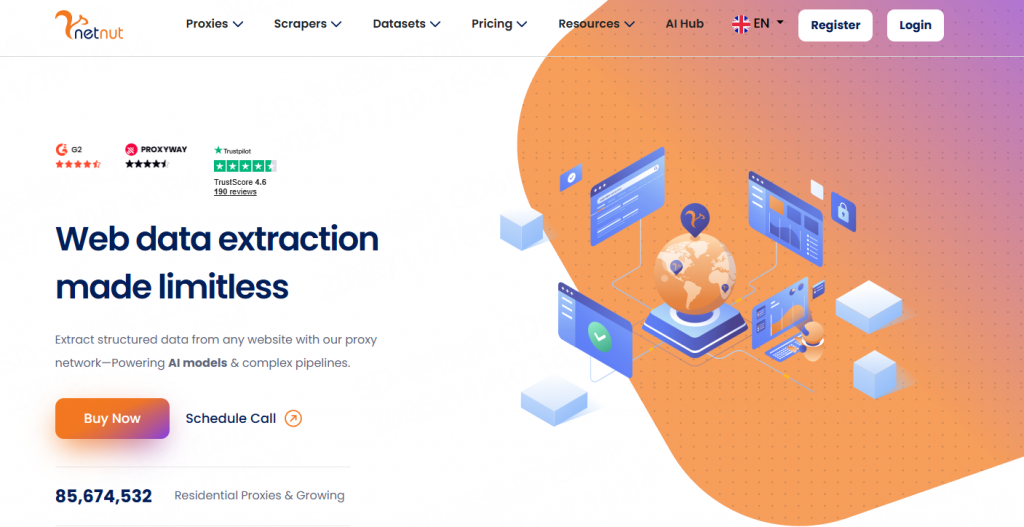
NetNut provides static residential proxies through direct connections to ISPs, without relying on P2P networks, thus ensuring more stable bandwidth and lower drop rates.
Key Features:
• Proxy Types: Residential Proxies, Datacenter Proxies, Mobile Proxies, ISP Proxies
• Network Size: 85 M+ IPs across 195+ countries/regions, supports geo-targeting
• Support: 24/7 live chat and email support
• Free Trial: 7-day free trial available
• Other Benefits: User-friendly dashboard, proxy management platform, onboarding documentation
Price:
• Residential Proxies: Starts from $1.59/GB
Cons:
• High Cost & Entry Barrier: Its premium pricing and minimum commitment requirements make it less accessible for smaller projects or startups.
• No Built-in Scraper Tools: NetNut provides raw proxy connectivity but lacks integrated solutions for handling CAPTCHAs, unlocking websites, or parsing data.
Dynamic pricing strategy
captures price fluctuations of competing products (such as updates every 15 minutes) and automatically triggers its own price adjustment (for example: $0.1 lower than the competitor)
Proxy requirements: 50+ residential IPs are required to rotate to avoid “frequent price comparison” detection
Inventory warning
monitors the inventory status of hot-selling SKUs and predicts the replenishment cycle (for example, seize the market when the competitor’s inventory is less than 50 pieces)
Category heat analysis
captures changes in BSR rankings (Best Seller Rank) and identifies emerging categories (e.g., yoga pants sales increased by 300% in the week)
Review semantic mining
collects TOP1000 product reviews and analyzes user pain points through NLP (e.g., “small size” has a mention rate of 25%)
New sellers sniping
Monitor the New Releases list to identify potential competitors (e.g., 3C sellers with a monthly growth rate > 200%)
Violation evidence collection:
Capture evidence of false reviews (such as multiple five-star reviews from the same IP) for reporting or negotiation
If you are reading this, you’ve probably seen the “503 Service Unavailable” error. Here is the technical reason why.
Amazon doesn’t just check your IP; they check your TLS Client Hello packet.
The Problem: Python’s `requests` library has a very distinct fingerprint. Even with a residential IP, Amazon knows you are a bot script, not a Chrome browser.
The Solution: You need a proxy provider (like Thordata) that performs “TLS Termination” and mimics a real browser handshake.
Datacenter IPs are cheap but have a 0% trust score with Amazon.
Residential IPs are trusted but slow and charged by Bandwidth (GB).
ISP Proxies: Hosted in data centers but registered under residential ASNs. They are fast, unlimited bandwidth, and trusted. Use these for Amazon.
With AI-enhanced detection systems and evolving strategies, Amazon data scraping will continue to challenge even the most seasoned professionals. However, proxy providers are also evolving quickly to offer smarter, safer, and more scalable solutions.
Whether you’re an independent developer or an enterprise data team, the right Amazon proxy provider can transform your data strategy. When making your decision, focus on performance, ethical use, and long-term reliability.
Ready to scale your Amazon business? Start by trying a proxy provider tailored to your needs and experience the difference a smart proxy strategy can make.
Frequently asked questions
How many proxies do I need?
It depends on your request volume, concurrency, and tolerance for blocks.
– Small projects: a few hundred IPs or a small pool may suffice.
– Large-scale projects: thousands of rotating IPs across multiple GEOs are common.
Always start with a trial or a smaller plan and scale based on real metrics.
What is the best type of proxy for Amazon scraping?
Residential proxy: Home IP assigned by real ISP, the most difficult to detect and block, suitable for large-scale, long-session crawling.
ISP static proxy: Static residential proxy, fast speed, stable connection, and almost no verification code.
Is it legal to scrape Amazon?
The legality of scraping Amazon data depends on the type of data and the method of scraping. For example:
– Under US law, scraping public product pages is generally not illegal. However, collecting reviews associated with an account may violate privacy regulations.
Best Practices:
– Only scrape publicly visible product and pricing information.
– If you plan to conduct large-scale commercial scraping, limit the number of requests and follow the regulations of robots.txt.
Can I use free proxies for Amazon?
About the author
Yulia is a dynamic content manager with extensive experience in social media, project
management, and SEO content marketing. She is passionate about exploring new trends in technology and cybersecurity,
especially in data privacy and encryption. In her free time, she enjoys relaxing with yoga and trying new dishes.
The thordata Blog offers all its content in its original form and solely for informational intent. We do not offer any guarantees regarding the information found on the thordata Blog or any external sites that it may direct you to. It is essential that you seek legal counsel and thoroughly examine the specificterms of service of any website before engaging in any scraping endeavors, or obtain a scraping permit if required.
 Looking for
Top-Tier Residential Proxies?您在寻找顶级高质量的住宅代理吗?
Looking for
Top-Tier Residential Proxies?您在寻找顶级高质量的住宅代理吗?
How to Scraping Dynamic Websites with Python?
In this article, learn how to ...
Anna Stankevičiūtė
2026-03-03
Scraping Yahoo Finance using Python
Xyla Huxley Last updated on 2026-03-02 10 min read […]
Unknown
2026-03-03
TCP Deep Dive with Wireshark
Xyla Huxley Last updated on 2026-03-03 6 min read TCP i […]
Unknown
2026-03-03
Web Scraping with Python using Requests
Xyla Huxley Last updated on 2026-03-03 6 min read Web c […]
Unknown
2026-03-03
Crawl4AI: Open-Source AI Web Crawler with MCP Automation
Xyla Huxley Last updated on 2026-03-03 10 min read AI a […]
Unknown
2026-03-03

Using Wget with Python: A Practical Guide for Reliable, Scalable Web Data Retrieval
Xyla Huxley Last updated on 2026-03-03 10 min read […]
Unknown
2026-03-03

How to Make HTTP Requests in Node.js With Fetch API (2026)
A practical 2026 guide to usin ...
Kael Odin
2026-03-03

How to Scrape Job Postings in 2026: Complete Guide
A 2026 end-to-end guide to scr ...
Kale Odin
2026-03-03

BeautifulSoup Tutorial 2026: Parse HTML Data With Python
A 2026 step-by-step BeautifulS ...
Kael Odin
2026-03-03
