


Web Scraper API
Fetch real-time data from 100+ websites,No development or maintenance required.
SCRAPING SOLUTIONS
Get accurate and in real-time results sourced from Google, Bing, and more.
With 120+ prebuilt and custom scrapers ready for any use case.
No blocks, no CAPTCHAs—unlock websites seamlessly at scale.
Execute scripts in stealth browsers with full rendering and automation
PROXY INFRASTRUCTURE
Over 100 million real residential IPs from genuine users across 190+ countries.
Reliable mobile data extraction, powered by real 4G/5G mobile IPs.
For time-sensitive tasks, utilize residential IPs with unlimited bandwidth.
Fast and cost-efficient IPs optimized for large-scale scraping.
SCRAPING SOLUTIONS
PROXY INFRASTRUCTURE
DATA FEEDS
Full details on all features, parameters, and integrations, with code samples in every major language.
LEARNING HUB
ALL LOCATIONS Proxy Locations
TOOLS
RESELLER
Get up to 50%
Contact sales:partner@thordata.com
Products $/GB
Fetch real-time data from 100+ websites,No development or maintenance required.
Get real-time results from search engines. Only pay for successful responses.
Execute scripts in stealth browsers with full rendering and automation.
Bid farewell to CAPTCHAs and anti-scraping, scrape public sites effortlessly.
Dataset Marketplace Pre-collected data from 100+ domains.
Over 100 million real residential IPs from genuine users across 190+ countries.
Reliable mobile data extraction, powered by real 4G/5G mobile IPs.
For time-sensitive tasks, utilize residential IPs with unlimited bandwidth.
Fast and cost-efficient IPs optimized for large-scale scraping.

Data for AI $/GB
Pricing $0/GB
Docs $/GB
Full details on all features, parameters, and integrations, with code samples in every major language.
Resource $/GB
EN $/GB
产品 $/GB
AI数据 $/GB
定价 $0/GB
产品文档 $/GB
资源 $/GB
简体中文 $/GB
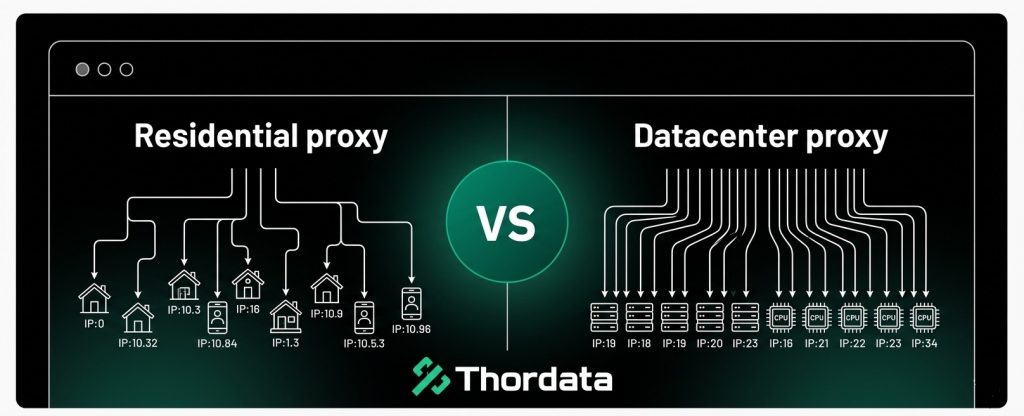
When evaluating proxy infrastructure, many teams focus on price first. In practice, compatibility with the workload matters more. The residential proxy vs datacenter proxy decision directly affects success rates, geo accuracy, data quality, and total operating cost.
If the proxy type does not match the target environment, even a strong setup can still produce failed requests, reruns, and wasted engineering time. That is why choosing the best proxy for web scraping should be based on fit, not just sticker price.
Datacenter proxies route traffic through servers hosted in commercial cloud or hosting environments. They are typically fast, cost-efficient, and easy to scale, making them well suited for high-volume standardized workloads.
Residential proxies route traffic through IP addresses assigned by real ISPs to household users. Because of that, they are often more suitable for tasks where localized visibility, geographic realism, and session consistency matter.
At a high level, the residential proxy vs datacenter proxy choice is a tradeoff between authenticity, stability, and cost efficiency.
The source of the IP has a direct impact on important metrics such as:
For public endpoints, lower-restriction websites, and straightforward extraction tasks, datacenter proxies are often sufficient and can deliver better throughput.
For localized pricing, regional search results, and market research based on what users in a real location see, residential proxies are often the better fit.
Datacenter proxies are not a worse product — they’re a different tool. They’re the right choice when:
The target site has minimal anti-bot measures. Internal tools, open data APIs, government data portals, and simpler e-commerce platforms often don’t run fingerprinting. Datacenter IPs work cleanly here, and the cost advantage is real.
Speed is the primary requirement. Datacenter proxies typically deliver lower latency than residential. For tasks where you need to move fast and the target doesn’t scrutinize IP reputation, datacenter wins on throughput.
Volume is high and margins are thin. If you’re pulling millions of requests from targets that don’t actively block datacenter ranges, the per-IP cost of datacenter infrastructure is significantly lower than per-GB residential pricing.
Session identity doesn’t matter. Tasks that don’t require maintaining a consistent user identity — purely extracting static data, for instance — don’t need the session persistence that residential proxies offer.
Several use cases effectively require residential IPs:
E-commerce price monitoring at scale. Amazon, Walmart, Target, and most major retailers actively identify and block datacenter IP ranges. A residential proxy presenting as a genuine shopper in the target region gets the real, localized price — including dynamic pricing, local promotions, and regional inventory data.
SERP data collection. Google, Bing, and other search engines apply aggressive detection to automated traffic. Residential IPs achieve significantly higher success rates and return results that reflect what real local users actually see, including personalization and localized results that datacenter IPs often miss.
Ad verification. Checking how your ads render for users in specific regions requires IPs that represent those users credibly. An ad platform will show different creatives, pricing, or targeting to a detected bot IP versus a genuine residential address.
Social media account management. Platforms including Facebook, Instagram, TikTok, and Twitter/X apply behavioral analysis that goes beyond simple IP checks. Residential IPs — especially when paired with an antidetect browser — significantly reduce account flags and bans. For this use case, mobile proxies (IPs assigned to actual mobile devices on carrier networks) often perform even better.
Localized content research. If you need to see what a website actually shows to users in a specific city or region — product availability, pricing, content variations — you need an IP that genuinely originates from that location. Datacenter IPs routed through a region don’t produce the same result.
One of the most common mistakes in the residential proxy vs datacenter proxy comparison is focusing only on purchase price.
A more useful metric is total cost per clean result, including:
In more demanding environments, residential proxies may cost more upfront, but they can still produce a lower effective cost if they deliver more usable data with fewer interruptions.
Start with three questions:
If the workload depends on scale, speed, and cost control, datacenter proxies may be the right choice. If it depends on localized accuracy, stability, and realistic access conditions, residential proxies are often the better fit.
Thordata provides both proxy types with the configuration flexibility for either workflow:
Residential proxies — 100M+ real IPs, 190+ countries, rotating or sticky sessions up to 90 minutes, city and ASN-level targeting, from $0.65/GB.
Datacenter proxies — dedicated IPs, fast throughput, from $0.75/IP, suitable for high-volume tasks on lower-scrutiny targets.
For teams that need SERP data specifically without managing either proxy type, Thordata’s SERP API handles the infrastructure layer entirely and returns structured JSON output directly.
The starting point is always the use case. Match the proxy type to the target, and the infrastructure works. Reverse it, and you’ll spend more time troubleshooting than collecting data.
Residential proxy vs datacenter proxy is not about which option is universally better. It is about which one fits your workload.
For high-volume, lower-complexity tasks, datacenter proxies are often more efficient. For tasks that require accurate local visibility and more stable results, residential proxies are often the better option.
The best proxy for web scraping is the one that matches your target, your data requirements, and your operating model.
FAQ:
 Looking for
Top-Tier Residential Proxies?您在寻找顶级高质量的住宅代理吗?
Looking for
Top-Tier Residential Proxies?您在寻找顶级高质量的住宅代理吗?
Best Residential Proxy Providers in 2026
Compare 5 residential proxy pr ...
Jenny Avery
2026-06-10

SERP Data Collection in 2026: When to Use a SERP API vs Managing Your Own Proxies
Compare SERP API vs residentia ...
Jenny Avery
2026-06-10

New Trends in Web Data Scraping in 2026: How Does Thordata’s Residential Proxy Solve the Anonymity and Stability Challenges?
When data becomes the oil of the new era, the scraping […]
Unknown
2026-06-10

Residential Proxies for AI Data Collection: A Practical Setup Guide
A practical guide to residenti ...
Jenny Avery
2026-06-10
Thordata Residential Proxy: The Ultimate Guide to AI-Powered Data Collection and Web Scraping Success
I’ll write a comprehensive, SE ...
Xyla Huxley
2026-06-10

How to Manage Multiple Social Media Accounts Without Getting Banned
Learn how to manage multiple F ...
Xyla Huxley
2026-06-10
5 Best Fingerprint Browsers for 2026
Fingerprint browsers have beco ...
Xyla Huxley
2026-06-09

Unlimited Residential Proxies: When They Make Sense and How to Choose the Right Plan
Unlimited residential proxies ...
Xyla Huxley
2026-06-08
Residential Proxies for Web Scraping
In this article, we will look ...
Xyla Huxley
2026-06-08